
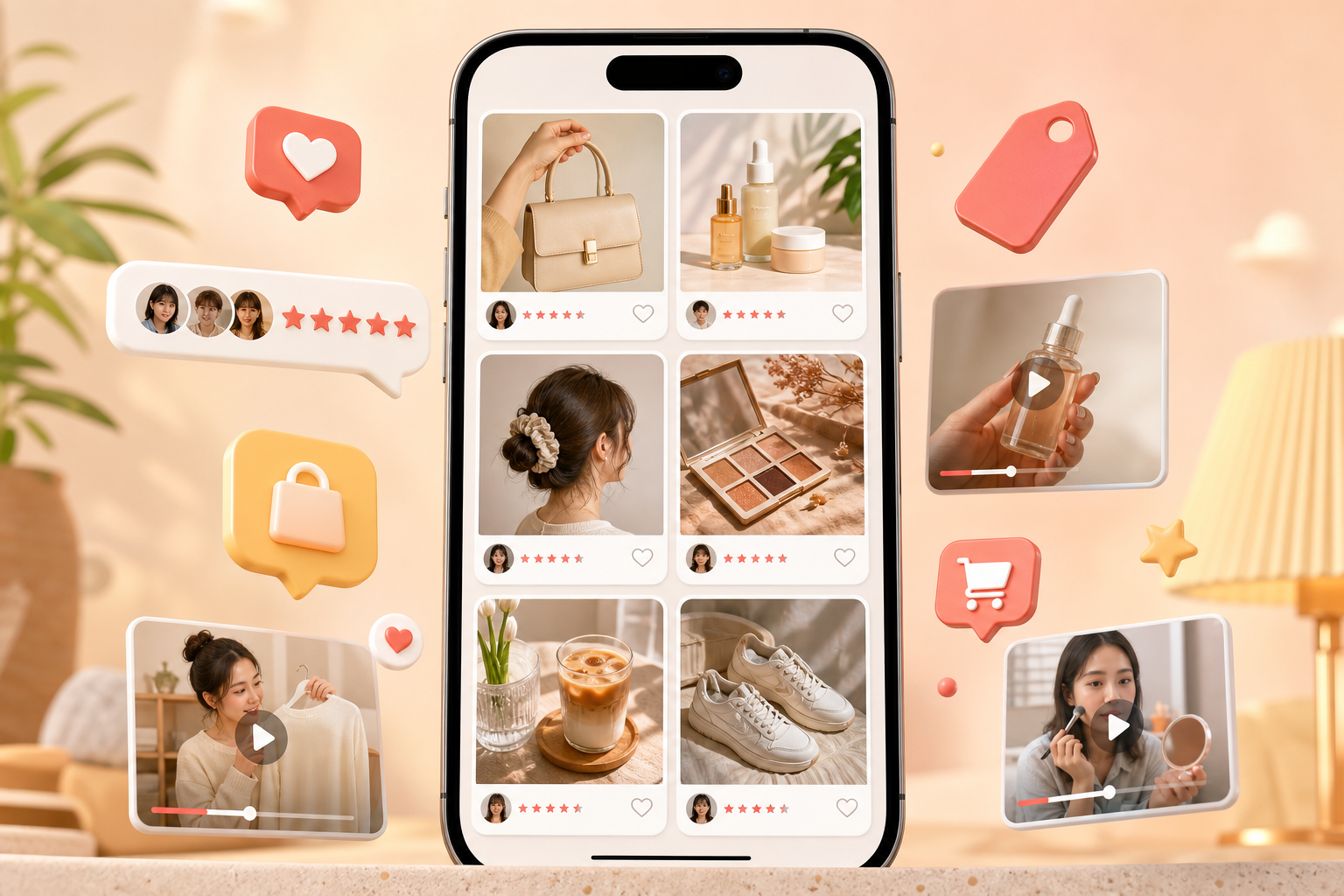
A practical guide to understanding Little Red Book and turning its high-intent audience into real customers.
Tap into Xiaohongshu's high-intent audience
Reach Chinese-speaking consumers in Singapore through the platforms where they actually shop.
Xiaohongshu is a social commerce platform, not just social media
Xiaohongshu, also known as Little Red Book or RED, blends Instagram-style photo and video sharing with a built-in e-commerce layer. Users browse lifestyle content, read peer reviews, and watch short videos, then purchase products without leaving the app. That closed loop between discovery and checkout is what makes the platform structurally different from a standard social network. On most platforms, a brand post might inspire a purchase that happens elsewhere. On Xiaohongshu, the entire journey from awareness to transaction happens inside one ecosystem, which concentrates purchase intent in a way that is difficult to replicate on general social media.
Who uses the platform and why that matters for brands
Xiaohongshu's core user base skews young, female, and urban. These are consumers who actively seek out product recommendations, lifestyle inspiration, and honest peer reviews before making buying decisions. Crucially, they treat the platform as a search engine for product discovery, typing in queries like "best sunscreen for oily skin" or "running shoes Singapore" the same way someone might use Google. For brands, this means users often arrive at your content already in a research mindset, with genuine purchase intent. That is a fundamentally different context from a user passively scrolling a feed, and it changes how content needs to be written and presented.
KOLs and micro-influencers are the engine of the platform
Xiaohongshu is built on trust, and trust on this platform flows through creators. Key Opinion Leaders (KOLs) and micro-influencers publish detailed, honest-feeling reviews and lifestyle posts that their followers treat as personal recommendations rather than advertising. Micro-influencers with smaller but highly engaged audiences often outperform larger accounts because their followers perceive them as peers rather than celebrities. Brands that partner with the right creators, those whose content style and audience genuinely match the product, see significantly stronger conversion than brands that push polished, overtly promotional material. This is the same principle behind KOL marketing agency services more broadly: fit and authenticity matter more than reach alone.
Content strategy on Xiaohongshu rewards specificity and authenticity
Generic brand content performs poorly on Xiaohongshu. The platform's algorithm and its users both reward posts that feel personal, detailed, and visually considered. A product review that explains exactly how a moisturiser performs on combination skin in humid weather will outperform a glossy campaign image with a tagline. Localized storytelling, written in the language and cultural register of the audience, is essential for brands targeting Chinese-speaking consumers in Singapore or mainland Chinese users. This is also where user-generated content becomes a practical asset: authentic content created by real users or creators carries the credibility the platform's audience expects.
Xiaohongshu fits into a broader social commerce strategy
For brands already active on TikTok Shop or Shopee, Xiaohongshu functions as a high-intent discovery layer that feeds the wider funnel. A consumer might first encounter a product through a Xiaohongshu review, then complete the purchase on another platform where the brand has a storefront. Understanding how these platforms interconnect is part of a coherent social media marketing strategy. Brands entering the Singapore market from China, or those targeting the Chinese-speaking community here, often find Xiaohongshu a natural starting point because the platform's content culture and user expectations already match what those consumers are used to.
When discovery and purchase happen inside the same app, every piece of content becomes a potential point of sale.
How to build a brand presence on Xiaohongshu
-
Define your audience and platform fit
Before creating any content, confirm that your target consumer actually uses Xiaohongshu. The platform's core audience is young, urban, and predominantly female, with strong interest in beauty, health, lifestyle, fashion, and food. If your product serves that profile, and especially if you are targeting Chinese-speaking consumers in Singapore or planning to reach mainland Chinese users, the platform is likely a strong fit. If your audience skews elsewhere, consider whether Xiaohongshu complements your existing channels rather than replacing them.
-
Set up a verified brand account
Brands can operate on Xiaohongshu through an official brand account, which unlocks access to advertising tools, analytics, and the ability to link products directly to posts. A verified account signals legitimacy to users who are accustomed to scrutinising whether a recommendation is genuine. Completing your profile with localized copy and visuals that match the platform's aesthetic is the first credibility signal your audience will see.
-
Identify and partner with the right creators
Creator selection is the most consequential decision you will make on Xiaohongshu. Look for KOLs and micro-influencers whose existing content style, audience demographics, and tone of voice genuinely match your product. A creator who already posts about skincare routines is a more credible partner for a beauty brand than a lifestyle generalist with a larger following. Engagement rate and comment quality are better signals of audience trust than follower count. Working with a KOL marketing agency can help you identify creators whose audiences convert, not just engage.
-
Produce content that fits the platform's native style
Xiaohongshu content that performs well tends to be detailed, personal, and visually clean rather than heavily produced. Think step-by-step tutorials, honest before-and-after comparisons, and specific product use cases tied to real situations. Avoid overtly promotional language; the platform's users are skilled at identifying and dismissing content that feels like an advertisement. Writing in Mandarin or using culturally relevant references significantly improves resonance with the platform's core audience. This is where UGC creation expertise becomes directly useful.
-
Use the platform's search behaviour to your advantage
Many Xiaohongshu users search for specific product categories or problems before they browse. Including relevant keywords naturally in your post titles and captions, the way a user would phrase a search query, increases the chance your content surfaces at the right moment. Treating Xiaohongshu as a search-driven discovery platform, not just a feed-based one, changes how you write titles and structure posts.
-
Measure, iterate, and connect to your wider funnel
Track which posts and creators drive the most profile visits, saves, and click-throughs to your storefront. Saves are a particularly strong signal on Xiaohongshu because they indicate a user intends to return to the content, often before making a purchase. Connect Xiaohongshu activity to downstream conversion data on platforms like Shopee or TikTok Shop to understand the full path to purchase. A coherent influencer marketing strategy ties these data points together so you can allocate budget to what actually converts.
Benefits
High purchase intent in one ecosystem
Xiaohongshu users move from product discovery to purchase without leaving the app. That closed loop concentrates buying intent in a way that general social platforms cannot replicate.
Peer trust outperforms traditional ads
The platform's review-driven culture means creator recommendations carry the weight of a trusted friend's opinion, not a paid placement, which significantly raises conversion likelihood.
Search-driven discovery reaches ready buyers
Users actively search for product categories and solutions on Xiaohongshu. Appearing in those search results puts your brand in front of consumers already in a research and buying mindset.
Direct access to Chinese-speaking consumers in Singapore
For brands targeting Singapore's Chinese-speaking community or planning cross-border reach, Xiaohongshu provides a culturally native environment where localized content resonates far more than translated material from other platforms.
Brands putting Xiaohongshu to work
A beauty brand entering the Singapore market
A skincare brand from China looking to establish credibility with Singapore's Chinese-speaking consumers uses Xiaohongshu as its primary discovery channel. Rather than running display ads, the brand partners with local micro-influencers who post detailed skin-type-specific reviews in Mandarin. The peer-review format builds trust faster than traditional advertising because the platform's audience already treats these posts as personal recommendations. Sales on the brand's Shopee storefront rise as users who discovered the product on Xiaohongshu complete their purchase there.
A health supplement brand targeting young urban women
A health supplement brand whose core buyer is a young, health-conscious urban woman finds that Xiaohongshu's user base matches its customer profile closely. The brand works with KOLs who already post about wellness routines, embedding the product naturally into existing content rather than commissioning standalone promotional posts. Content that shows the product as part of a real daily routine consistently outperforms product-only imagery. The brand tracks saves and profile visits as leading indicators before measuring downstream conversion.
An overseas brand using Xiaohongshu alongside Shopee
An overseas consumer goods brand uses Xiaohongshu for product discovery and Shopee for transaction, treating the two platforms as complementary parts of the same funnel. Xiaohongshu content drives awareness and purchase intent; the Shopee storefront closes the sale. Coordinating content calendars across both platforms ensures that a spike in Xiaohongshu interest is met with timely promotions on Shopee. This multi-platform approach is particularly effective for brands new to the Singapore market who need to build recognition before conversion. Learn more about Shopee livestream commerce campaigns as a complementary channel.
What is Xiaohongshu and how can brands use it
What is Xiaohongshu and how does it differ from Instagram?
Xiaohongshu (also called Little Red Book or RED) combines social content sharing with a built-in e-commerce layer, so users can discover and purchase products without leaving the app. Instagram is primarily a content and advertising platform where purchases typically happen off-platform. The key difference is that Xiaohongshu is built around peer reviews and product discovery, making its audience's purchase intent structurally higher than on a general social network.
Is Xiaohongshu relevant for brands selling in Singapore?
Yes, particularly for brands targeting Singapore's Chinese-speaking community or those entering the market from China. The platform's user base skews young, urban, and female, and many Singapore-based users actively use it to research products before buying. Localized content in Mandarin, written in the platform's native review style, performs significantly better than translated or repurposed content from other channels.
How do KOLs and micro-influencers work on Xiaohongshu?
KOLs and micro-influencers publish detailed, personal content, reviews, tutorials, and lifestyle posts, that their followers treat as trusted recommendations. Micro-influencers with smaller, highly engaged audiences often drive stronger conversion than large accounts because their followers perceive them as peers. Brands that match creators to their product category and audience profile, rather than selecting purely on follower count, consistently see better results.
Can Xiaohongshu work alongside other platforms like Shopee or TikTok Shop?
Xiaohongshu works well as a discovery and trust-building layer that feeds into transactional platforms. A consumer might find a product through a Xiaohongshu review and complete the purchase on Shopee or TikTok Shop. Coordinating content and promotions across platforms so that interest generated on Xiaohongshu is captured at the point of purchase elsewhere is a practical multi-platform approach many brands use.
Connect your brand with high-intent Xiaohongshu audiences
If your brand is targeting Chinese-speaking consumers in Singapore or looking to enter the market from China, Xiaohongshu is worth understanding as part of your social commerce mix. Talk to the Confetti team about how creator marketing and KOL partnerships can connect your brand to the audiences that are already looking for what you sell.