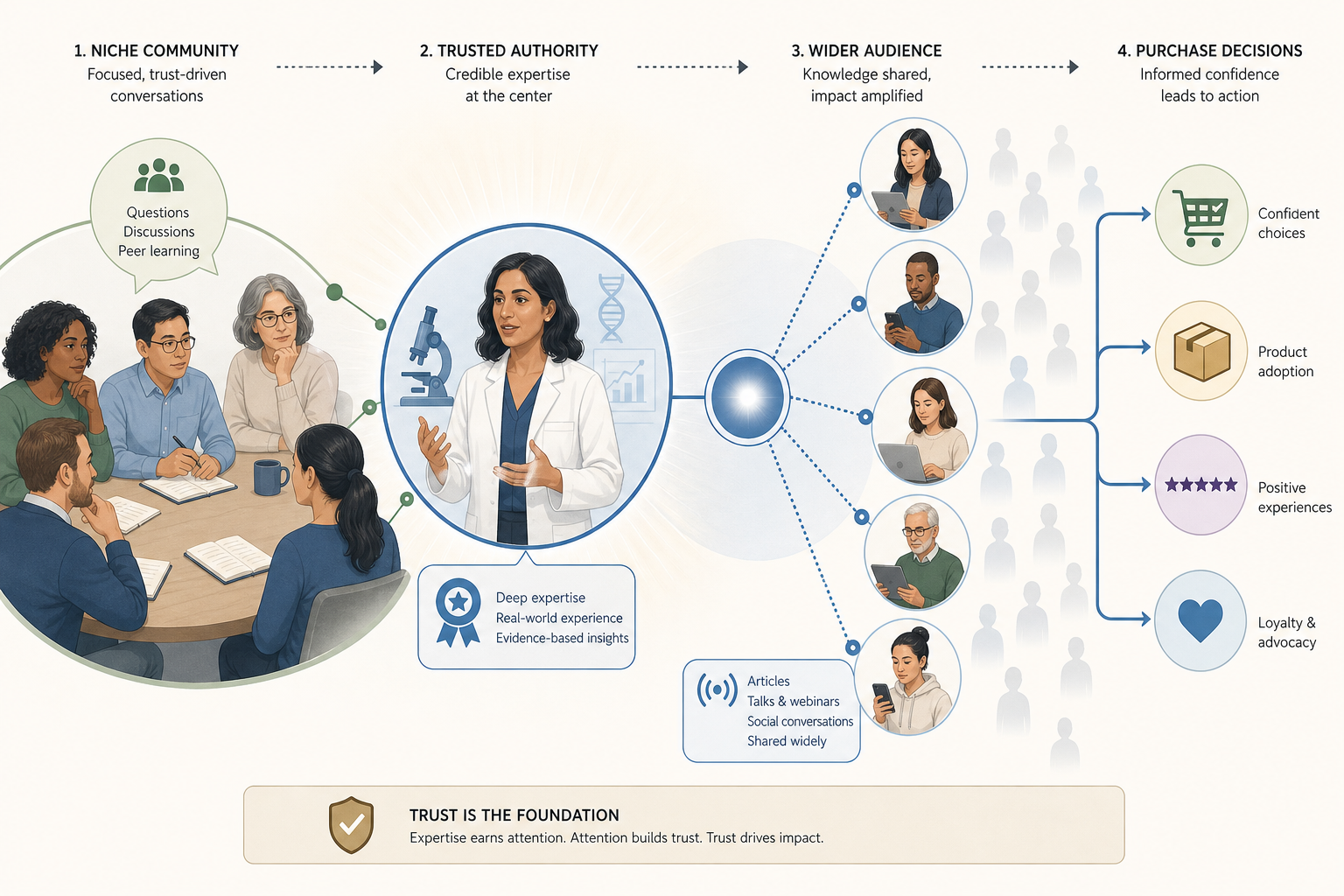
Key Opinion Leaders drive brand growth through trusted expertise, not just reach. Here is what that means in practice.
Put KOL expertise to work for your brand
Discover how KOL partnerships can build credibility and convert engaged audiences for your brand.
What a KOL actually is, and what sets them apart
KOL stands for Key Opinion Leader: an individual who holds recognised authority and credibility within a specific field, such as a dermatologist commenting on skincare, a certified financial analyst reviewing investment products, or an academic researcher cited in industry discussions. The defining quality is expertise that a targeted audience already trusts, not simply a large follower count.
This separates KOLs from general celebrities or broad-reach influencers. A celebrity endorses a product to a mass audience; a KOL advocates for it to an audience that actively seeks their professional judgment. That distinction matters because the audience's relationship with a KOL is built on perceived competence, not just affinity. For brands selling products where informed decisions matter, that trust translates directly into persuasive power.
How KOL influence actually shapes purchasing decisions
When a respected voice in a niche recommends a product, their audience interprets it as a signal that the product has passed a credible, expert filter. This is especially powerful in categories where buyers do research before purchasing: health supplements, skincare, financial services, professional tools, and edtech, among others.
The mechanism is different from mass advertising. A billboard creates awareness; a KOL creates conviction in an already-engaged audience. Followers of a niche KOL are often further along the decision journey, actively seeking guidance rather than passively consuming content. A well-placed KOL recommendation can therefore compress the path from awareness to purchase more efficiently than broad media placements. For brands active on platforms like TikTok Shop or Shopee, this effect is amplified because content and commerce sit on the same screen. You can read more about pairing KOL content with platform-specific strategy in our influencer marketing agency services overview.
The difference between KOLs, influencers, and celebrities
These three categories overlap but are not interchangeable. Celebrities carry broad name recognition across demographics but typically lack deep domain authority. Influencers build audiences around lifestyle, personality, or entertainment, and their credibility is relational rather than professional. KOLs earn their standing through verifiable expertise: qualifications, published work, industry recognition, or years of practitioner experience.
In practice, the lines blur. A fitness trainer with a large following who also holds professional certifications functions as both an influencer and a KOL. What matters for brand strategy is identifying which quality your campaign needs most: reach, relatability, or authority. Campaigns that need to overcome scepticism in informed audiences, such as health products or financial services, benefit most from the authority dimension that genuine KOLs bring. Our KOL marketing agency services page covers how this shapes campaign design.
Why niche reach often outperforms mass reach for brand growth
A KOL with a smaller but deeply engaged specialist audience can deliver stronger commercial outcomes than a mass-reach celebrity, particularly for brands with a defined target customer. The audience self-selects: people who follow a nutrition scientist are, by definition, interested in nutrition. That pre-qualification reduces wasted impressions and increases the proportion of the audience that is genuinely in-market.
Engagement rates in niche communities tend to run higher than those on broad entertainment accounts, and the comments and shares generated by KOL content often carry the conversation further than the original post. This organic amplification, driven by an audience that trusts the source, is difficult to replicate through paid placements alone. Brands pairing KOL advocacy with user-generated content creation can extend that credibility even further by letting the audience itself become part of the brand story.
Measuring KOL impact beyond vanity metrics
Reach and impressions tell you how many people saw a KOL post. They do not tell you whether anyone was persuaded. Effective KOL measurement tracks signals closer to the commercial outcome: click-through rates on product links, conversion rates on affiliated landing pages, uplift in branded search volume, and, where platform tools allow, direct attribution of sales to a specific creator.
On platforms like TikTok Shop and Shopee, attribution is more tractable than in traditional media because the purchase can happen within the same session as the content view. This makes it possible to compare KOL performance against a measurable revenue outcome rather than a proxy metric. Brands running Shopee livestream commerce campaigns alongside KOL content can track which creator touchpoints are actually driving transactions, giving campaign teams real data to optimise against.
A KOL's audience follows them for what they know, and that distinction is exactly what makes their brand advocacy so difficult to replicate through paid media alone.
How to build a KOL strategy that drives results
-
Define the authority your audience respects
Before identifying KOLs, clarify what kind of expertise your target customer defers to. A health supplement brand may need registered dietitians or sports scientists. A fintech brand may need credentialed analysts. Matching the type of authority to the audience's decision-making framework is the foundation of an effective KOL brief. Getting this wrong means reaching the right number of people with the wrong messenger.
-
Evaluate credibility, not just follower count
Assess KOL candidates on the signals their audience uses to judge them: professional qualifications, published content, industry affiliations, and the quality of engagement in their comments. Follower count is a secondary metric; a smaller audience that actively cites and shares a KOL's analysis is more valuable than a large passive following. Look for consistency of expertise across their content history, not just their most viral posts.
-
Brief for authenticity, not just messaging
KOL advocacy loses its power when it reads like a press release. Brief KOLs on the product's genuine attributes and let them translate it into their own expert voice. Provide factual support, sample products, and context, but give them room to form and express a real opinion. Audiences in expert communities are particularly sensitive to scripted-sounding endorsements and will discount them accordingly.
-
Match the platform to the content format
Different platforms favour different KOL content styles. Long-form analysis suits written platforms and YouTube; short expert commentary suits TikTok and Instagram Reels; live Q&A formats work well on TikTok Shop and Shopee Live. Choosing the platform where your audience already seeks expert guidance in your category increases the chance that KOL content reaches them in a receptive mindset. See how social media marketing agency services can inform platform selection.
-
Track performance against commercial outcomes
Set measurable goals before the campaign launches: conversion rate on a tracked link, sales attributed to a creator code, or change in branded search volume. Attribution tools built into platforms like TikTok Shop and Shopee make it possible to connect KOL content directly to purchase events, giving you a basis for comparing KOL return against other campaign types and for optimising creator selection in future campaigns.
Benefits
Credibility that advertising cannot buy
A KOL's endorsement carries the weight of their professional reputation, not just their platform reach. Audiences in expert communities treat KOL recommendations as informed signals, which is qualitatively different from how they process paid ads.
Direct access to pre-qualified niche audiences
KOL followers self-select around a shared interest or profession, meaning a brand's message reaches people who are already in-market or actively researching. This pre-qualification reduces wasted impressions and increases the proportion of the audience that can act on the recommendation.
Stronger persuasion in high-consideration categories
For products where buyers do research before purchasing, such as health, finance, or professional tools, expert-backed advocacy shortens the decision cycle by satisfying the audience's need for a credible, informed opinion.
Measurable attribution on social commerce platforms
Platforms like TikTok Shop and Shopee allow brands to connect KOL content directly to purchase events. Performance data from these platforms makes KOL ROI calculable, not just estimated, giving marketing teams a real basis for optimisation.
KOL marketing in practice across industries
Health supplement brand entering a sceptical market
A brand launching a new supplement range faces an audience that has been burned by overblown health claims before. Partnering with registered nutritionists or sports scientists who review the product's formulation in their own words gives the brand a credibility signal that no amount of paid advertising can replicate. The KOL's professional standing becomes the brand's borrowed authority. When that content is published on a platform like TikTok Shop where viewers can purchase immediately, the trust-to-transaction path is direct and measurable.
Financial services brand reaching informed investors
A fintech or investment platform needs to reach people who are already researching options, not casual browsers. A credentialed financial analyst or well-regarded market commentator speaking to their audience about a platform's features carries far more weight than a display ad. The audience's prior trust in the KOL transfers to the brand, reducing the friction that typically slows financial product adoption. This is a category where authority matters more than entertainment value.
Beauty brand using dermatologist-backed content
Skincare is a category dense with competing claims. A dermatologist or cosmetic chemist who breaks down the ingredient science of a product gives consumers the expert filter they are looking for. Content that explains why a formulation works outperforms content that simply shows results, because it respects the audience's intelligence and satisfies their research intent. Pairing this with UGC from everyday users creates a credibility stack: expert validation plus real-world social proof.
Overseas brand building trust in a new market
A brand expanding into Singapore from another market faces a trust deficit: local consumers have no prior relationship with it. Partnering with locally respected KOLs in the relevant category accelerates trust-building by associating the brand with voices the local audience already knows and respects. Local KOL endorsement signals that the brand is relevant and credible in the new context, not just transplanted from elsewhere. This is a common starting point for brands using Confetti's local expansion service.
What are KOLs and why do they matter for brand growth?
What is the difference between a KOL and an influencer?
An influencer builds an audience around personality, lifestyle, or entertainment, and their credibility is relational. A KOL earns their standing through verifiable domain expertise, such as professional qualifications, published work, or industry recognition. In practice the categories overlap, but the key distinction is whether the audience follows them for who they are or for what they know.
Which industries benefit most from KOL marketing?
KOL marketing is most effective in categories where buyers do significant research before purchasing and where expert opinion is actively sought. Health and wellness, financial services, skincare, and edtech are strong examples. In these categories, a credentialed KOL can resolve scepticism that advertising alone cannot overcome.
How do you measure whether a KOL campaign actually worked?
The most reliable measures are those closest to a commercial outcome: conversion rates on tracked links, sales attributed to creator codes, and direct purchase attribution available on platforms like TikTok Shop and Shopee. Reach and impressions are useful context but should not be the primary success metric for a performance-focused campaign.
How does KOL marketing connect to broader influencer and social commerce strategy?
KOL campaigns work best when integrated with a wider content and commerce strategy. Expert KOL content can sit alongside UGC, livestream commerce, and platform-specific campaigns to create multiple credibility signals at different stages of the buyer journey. Agencies like Confetti that operate across these formats can coordinate the layers so they reinforce each other rather than running in isolation.
Ready to build a KOL campaign with measurable impact
KOL marketing works when the right expert voice reaches the right audience on the right platform. If you are planning a campaign that needs genuine authority behind it, Confetti's KOL and creator marketing services are built to deliver measurable outcomes, not just impressions. Explore how a performance-focused KOL strategy could work for your brand.