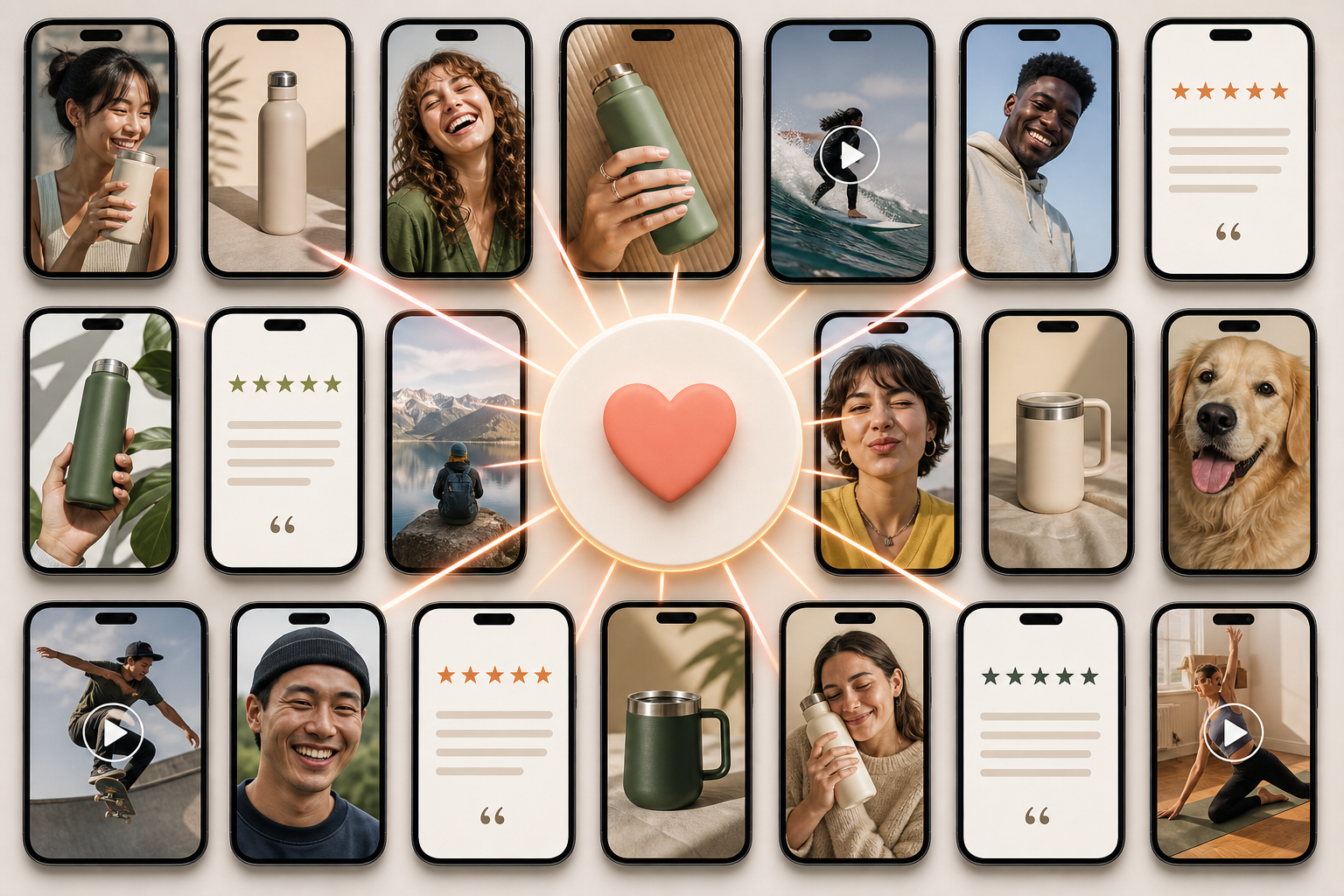
UGC marketing turns authentic photos, videos, and reviews into a trust engine that moves buyers from interest to purchase.
Turn customer content into a conversion engine
Discover how to build a UGC strategy that generates genuine content and measurable sales results.
What makes UGC different from standard branded content
User-generated content (UGC) is any photo, video, review, or social post that a real customer creates about a product or brand, without being scripted or produced by the brand itself. The fundamental difference from a polished ad is origin: the creator has no obligation to say anything positive, which is exactly why audiences read it as credible. Consumers are accustomed to filtering out advertising, but a candid unboxing clip or a genuine review from someone who actually bought the product reads as peer advice rather than promotion. That shift in perception is what gives UGC its conversion power. Authenticity, not production quality, is the currency that makes UGC work. A shaky phone video that shows a real result will routinely outperform a slick studio ad on social platforms, because the audience recognises the difference immediately.
How UGC reduces purchase hesitation at every stage
Buyers move through a predictable sequence: they become aware of a product, consider whether it suits them, and then decide whether to trust it enough to spend money. UGC operates at all three stages but is most powerful at the consideration and trust stages. A potential buyer searching for a skincare product will weigh a brand's own claims against what other buyers have experienced. Reviews, before-and-after photos, and honest video walkthroughs act as social proof that bridges the gap between interest and purchase. On platforms like TikTok and Shopee, this dynamic is compressed into seconds: a short clip of someone using a product in a real setting can answer the questions a product page cannot. For brands selling through social commerce channels, UGC is not a nice-to-have; it is a core part of the purchase funnel.
Collecting UGC legally and with proper permissions
Repurposing a customer's post without permission is a legal and reputational risk. The practical standard is to ask explicitly: brands can do this through direct message, a comment reply, or a structured submission form. Many brands build permission into their campaigns from the start by running hashtag campaigns with clear terms that state the brand may repost or use submitted content in marketing. This removes ambiguity for both parties. When UGC is collected through a brief given to creators, as is common in managed UGC programmes, the usage rights should be documented in writing before any content goes live. Keeping a record of permissions is especially important when content will be repurposed across multiple channels or paid media, where the stakes of an unlicensed use are higher. The UGC creation services that agencies provide typically include rights management as part of the process.
Which platforms and formats perform best for UGC
Platform choice should follow audience behaviour, not brand preference. Short-form video UGC performs strongly on TikTok, where the algorithm surfaces content based on engagement rather than follower count, meaning a genuine customer clip can reach a large audience without paid amplification. Photo and caption-driven UGC tends to perform well on platforms with a discovery-first structure, such as Xiaohongshu and Lemon8, where users actively search for product recommendations. Reviews and ratings remain the most widely consulted form of UGC on e-commerce platforms like Shopee, where they appear at the point of purchase decision. The most effective UGC strategies do not pick one format; they generate content in the formats native to each platform and let the content do the work it is best suited for.
Encouraging UGC without losing the authenticity that makes it work
The challenge is that incentivising content creation can undermine the genuine quality that makes UGC credible. The practical balance is to lower the barrier to participation without scripting the outcome. Hashtag campaigns, community challenges, and post-purchase prompts encourage customers to share naturally, while leaving the content itself up to them. When brands work with creators through a managed UGC programme, the brief should define the format and topic, not the verdict: a creator can be asked to show how they use a product, but not told to call it the best they have ever tried. KOLs and micro-influencers occupy a useful middle ground here: their content feels personal and trusted by their audience, while giving brands more predictability than purely organic UGC. For more on how creator partnerships fit into this, see KOL marketing and influencer marketing.
A shaky phone video that shows a real result will routinely outperform a slick studio ad, because the audience recognises the difference immediately.
How to build a UGC marketing strategy step by step
-
Define the content you actually need
Start by mapping your purchase funnel and identifying where buyers drop off. If the gap is at consideration, you need content that demonstrates the product in use. If it is at trust, reviews and testimonials matter more. Knowing what job the content needs to do determines what formats to prioritise and which platforms to focus on, before you ask anyone to create anything.
-
Build a collection mechanism into your campaign
Organic UGC does not appear reliably without a prompt. A hashtag campaign, a post-purchase email asking for a review, or a community challenge all give customers a clear invitation and a place to put their content. The mechanism should make participation easy: a simple hashtag is lower friction than a submission form, but a form gives you cleaner rights documentation. Choose based on the volume and quality balance you need.
-
Establish usage rights before repurposing
Before any customer content appears in your paid ads, website, or social channels, confirm you have explicit permission. For organic posts, a direct message asking for permission and a reply granting it is a minimum. For structured campaigns, include usage terms in the campaign brief or entry conditions. Documented rights protect both the brand and the creator and become especially important when content is used in paid media placements.
-
Supplement organic UGC with managed creator content
Purely organic UGC can be unpredictable in volume and quality. Many brands supplement it with a managed UGC programme: creators are briefed on format and topic but given creative freedom on the actual content. This produces content that retains an authentic feel while giving the brand more control over consistency and posting cadence. Agencies that specialise in UGC creation manage this process end to end, including creator matching and rights clearance.
-
Activate UGC across the right channels
UGC collected in one place can be repurposed across several. A customer video review can become a TikTok post, a product page asset, and a paid social ad creative, each doing a different job. Repurposing extends the value of every piece of content without requiring new production. Match the format to the platform: short video for TikTok, photo and caption for Xiaohongshu, ratings and written reviews for Shopee product listings.
-
Measure performance and refine the content mix
Track which UGC formats and topics drive the outcomes you defined in step one: click-throughs, add-to-cart rates, conversion rates, and review volume. Performance data tells you what kind of content your audience actually responds to, which is more reliable than assumptions about what looks good. Use that data to brief future creators more precisely and to allocate budget toward the formats that are working.
Benefits
Builds trust faster than ads
Content created by real customers carries an implicit endorsement that branded advertising cannot replicate. Peer-created content is read as genuine advice rather than promotion, which shortens the trust-building process for new buyers.
Reduces purchase hesitation at the point of decision
Reviews, video walkthroughs, and candid photos answer the questions a product page cannot. Social proof at the moment of decision directly reduces the friction that causes buyers to abandon a purchase.
Extends content reach without proportional cost
A single piece of strong UGC can be repurposed across TikTok, Shopee, a brand's own website, and paid social ads. One piece of authentic content does multiple jobs across the funnel without requiring repeated production investment.
Feeds platform algorithms with high-engagement content
On TikTok in particular, content that earns genuine engagement, comments, shares, and watch time is surfaced to wider audiences. Authentic UGC tends to outperform polished brand content on engagement metrics, which drives organic reach.
Creates a compounding content library
Each campaign that generates UGC adds to a library of assets the brand owns and can reuse. Over time, a growing bank of rights-cleared content reduces dependence on new production and provides a diverse pool of creative to test.
UGC marketing in practice across different brand types
A beauty brand launching a new skincare line
A beauty brand entering a competitive skincare category faces a credibility problem: consumers have seen many product claims and are sceptical of brand-produced before-and-after imagery. Running a hashtag campaign that invites existing customers to share their results, combined with a managed UGC programme using micro-creators who fit the target demographic, generates a library of authentic content showing real results on real skin. This content can then be used across TikTok, Xiaohongshu, and Shopee product pages, addressing purchase hesitation at each stage of the funnel. For platforms like Xiaohongshu specifically, see how brands use it for social commerce.
An overseas brand entering the Singapore market
A brand from China expanding into Singapore faces an audience that does not yet recognise the name or trust the product. UGC from local creators and early customers acts as localised social proof that speaks directly to the Singapore consumer's context, language, and preferences. Combining this with KOL partnerships accelerates credibility-building in a market where peer recommendations carry significant weight. For more on how key opinion leaders fit into a market entry strategy, that relationship between UGC and KOL content is worth understanding before launching.
A health supplement brand on Shopee
Health supplement buyers are particularly cautious because the category involves personal wellbeing and is crowded with competing claims. Verified purchase reviews and video testimonials from real users carry more weight in this category than almost any other content type. A brand that actively prompts post-purchase reviews, responds to them publicly, and repurposes the strongest ones as product page assets and Shopee livestream content builds a compounding trust advantage over competitors who rely solely on brand-produced materials.
A lifestyle brand running a TikTok Shop campaign
On TikTok Shop, the path from content to purchase is deliberately short: a viewer can buy directly from a video or a live show without leaving the app. UGC-style short videos, whether from real customers or creators briefed to produce authentic-feeling content, perform better in TikTok's algorithm than polished ads because they generate higher engagement and watch time. A lifestyle brand that builds a content pipeline of creator-produced UGC can maintain a consistent presence in the feed without the cost and lead time of traditional ad production.
Common questions about UGC marketing
What is the difference between UGC and influencer marketing?
UGC refers to content created by real customers or consumers, often without a formal paid arrangement, while influencer marketing involves a structured partnership where a creator is compensated to produce and publish content. In practice, the lines blur: managed UGC programmes often brief creators to produce content that feels organic, even though the relationship is paid. The key distinction is that UGC prioritises the authentic feel of the content, whereas influencer marketing prioritises the creator's audience reach. Many effective strategies combine both, using influencer partnerships to seed awareness and organic UGC to sustain trust.
Do I need permission to repost a customer's photo or video?
Yes. Reposting a customer's content without explicit permission is a legal risk, even if the post was public and tagged the brand. The standard practice is to ask directly via comment or direct message and keep a record of the permission granted. Campaigns that build permission into the entry terms (for example, a hashtag campaign with stated usage rights) are cleaner to manage at scale. For paid media use, written rights clearance is strongly recommended.
Which platforms are best for UGC marketing in Singapore?
It depends on your audience and product category. TikTok is strong for short-form video UGC with direct purchase links through TikTok Shop. Shopee is critical for review-based UGC at the point of purchase. Xiaohongshu and Lemon8 are particularly effective for discovery-driven UGC in beauty, lifestyle, and food categories, where users actively search for peer recommendations. A multi-platform approach, with content formats matched to each platform's native behaviour, typically outperforms a single-channel strategy.
How do I encourage customers to create UGC without it feeling forced?
The most effective prompts are low-friction and leave creative control with the customer. Post-purchase emails, hashtag campaigns, and community challenges all invite participation without dictating the outcome. Avoid over-scripting the content: asking a customer to share how they use a product yields more authentic results than asking them to say specific things. Incentives like early access or recognition in the brand's own channels can increase participation without compromising the genuine quality that makes UGC credible.
Build a UGC strategy that connects content to sales
If you want to build a UGC strategy that generates genuine content and connects it to measurable sales outcomes, the approach matters as much as the content itself. Confetti works with brands across beauty, lifestyle, health, and consumer goods to develop and manage UGC programmes on TikTok Shop, Shopee, and beyond.