From product listings to live sales: a practical guide to TikTok Shop for brands selling in Singapore.
Put your brand in front of TikTok Shop buyers
Explore how Confetti helps brands turn TikTok Shop into a consistent sales channel.
TikTok Shop turns content into a checkout
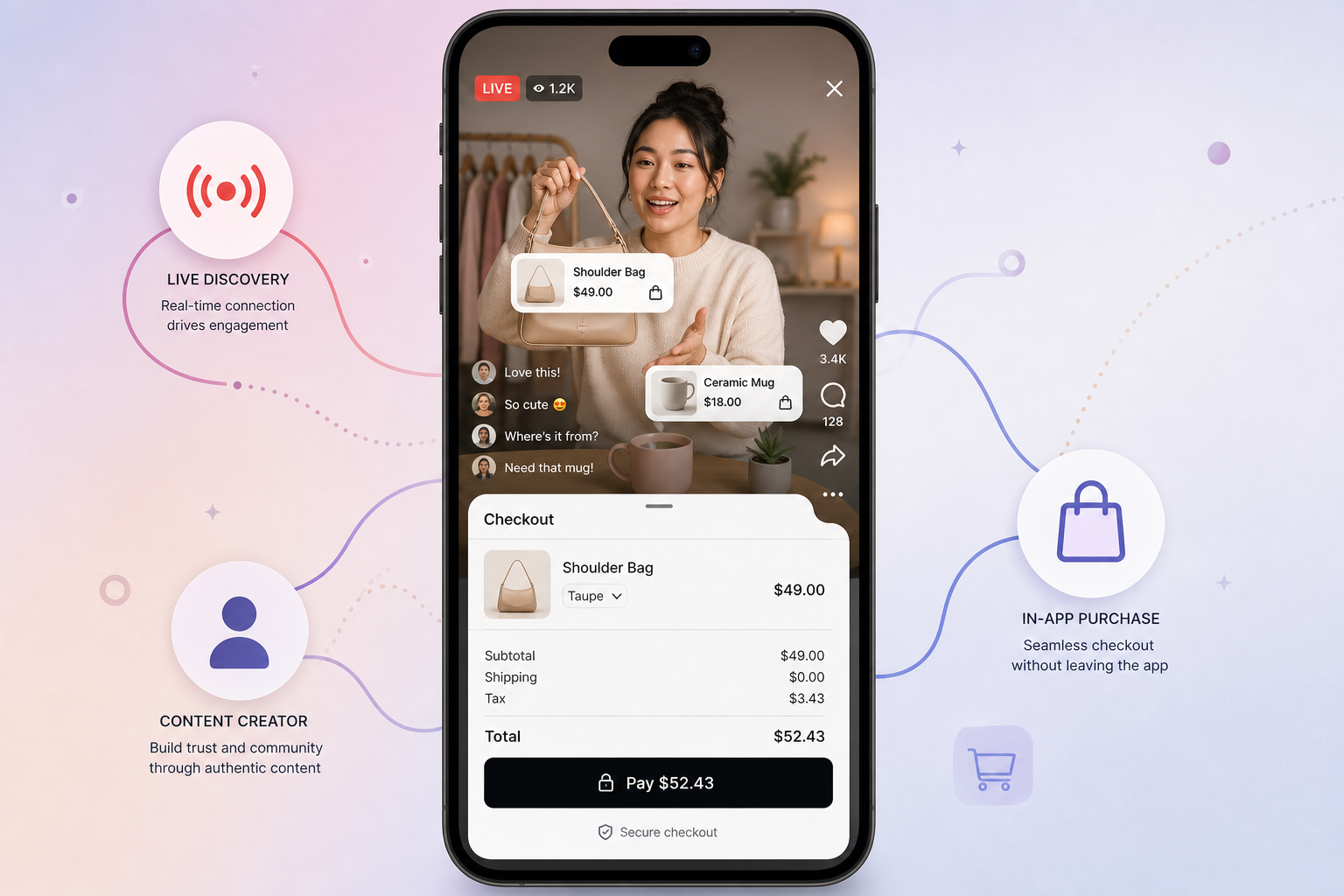
TikTok Shop is an e-commerce feature built directly into the TikTok app. Unlike linking out to a separate website, it lets shoppers discover a product inside a video or livestream and complete the purchase without ever leaving the platform. That single shift, collapsing the gap between discovery and transaction, is what makes TikTok Shop structurally different from conventional social media advertising. For brands, this means a short video or a live show is not just content: it is a storefront. Products appear as clickable tags in videos, as pinned items during livestreams, and as listings inside a dedicated Shop tab that users can browse directly. The purchase path is as short as two taps, which removes a significant source of drop-off that affects campaigns driving traffic to external sites.
How TikTok Shop is set up in Singapore
In Singapore, TikTok Shop operates as a localised marketplace. Sellers register through TikTok Seller Center, list products priced in Singapore dollars, and fulfil orders via supported logistics partners. Shoppers encounter products either through the For You feed, where the algorithm surfaces relevant content, or by browsing the Shop tab directly. The platform functions as both a discovery engine and a marketplace, which means a brand's reach is partly organic: a well-performing video can introduce products to audiences who were not actively searching. This is a meaningful difference from platforms like Shopee, where shoppers typically arrive with purchase intent already formed. For brands new to the Singapore market, TikTok Shop offers a way to build awareness and drive sales simultaneously. Overseas brands entering Singapore, a common use case for agencies like Confetti, can use TikTok Shop as a primary channel for local market entry alongside platforms such as Shopee.
The three main sales surfaces brands use
Brands on TikTok Shop sell through three distinct surfaces, and most successful accounts use all three in combination. Short videos with tagged products generate passive, always-on sales: a video published today can keep driving purchases weeks later if the algorithm continues to distribute it. Livestream commerce is the highest-intensity surface, where a host presents products in real time, answers questions, and creates urgency through limited-time offers during the broadcast. Livestreams tend to convert at higher rates during the session itself because the format is interactive and immediate. The third surface is the in-app storefront, the brand's Shop tab, which functions like a mini product catalogue and captures shoppers who arrive from search or from a creator's profile. Each surface suits a different moment in the buyer journey, and brands that coordinate across all three typically see stronger overall results.
Affiliate creators are central to how the platform works
TikTok Shop's affiliate programme is one of its most commercially important features. Brands list their products in an affiliate marketplace, and creators, ranging from nano-influencers to established KOLs, apply to promote them in exchange for a commission on each sale they generate. This makes creator marketing on TikTok Shop inherently performance-based: the brand pays for results rather than for reach alone. A creator who produces a video featuring a product earns a percentage of every purchase made through their unique link or tagged product. For brands, the model reduces upfront creative risk and scales distribution without requiring a large internal content team. The trade-off is that brand messaging depends on how individual creators choose to present the product, which makes creator selection and briefing genuinely important. UGC and creator content strategy becomes a core operational concern, not just a marketing add-on.
What managing a TikTok Shop account actually involves
Running a TikTok Shop account is more operationally intensive than maintaining a standard social media presence. The Seller Center is where brands manage product listings, inventory, pricing, orders, and affiliate relationships. Brands also need to monitor performance data, including video views, click-through rates on product links, and conversion rates per listing, to understand which content is driving sales and which is not. On the content side, a consistent output of short videos is necessary because the algorithm rewards recency and engagement. For livestream commerce, the requirements go further: a host, a production setup, a structured script, and real-time audience management are all part of a successful show. Many brands, particularly those entering Singapore from overseas or scaling quickly, work with a TikTok Shop partner agency to handle production and strategy rather than building this capability entirely in-house.
A short video with a tagged product is simultaneously content and a storefront, and it keeps selling long after the camera stops.
How to get started on TikTok Shop as a brand
-
Register on TikTok Seller Center
The starting point is creating a seller account through TikTok Seller Center, the backend platform where all product and order management happens. In Singapore, this requires business registration documents and a local bank account for payouts. Once approved, the account is linked to a TikTok business profile, which becomes the brand's public-facing storefront.
-
Set up and organise product listings
Each product needs a listing with images, a description, pricing in Singapore dollars, and stock information. Well-optimised listings matter because they appear both in the Shop tab and as tagged products in videos and livestreams. Brands should treat listing copy with the same care as any product page: clear titles, accurate descriptions, and images that hold up on a mobile screen.
-
Produce short videos with tagged products
Short-form video is the primary discovery mechanism on TikTok. Brands either produce videos in-house or work with creators through the affiliate programme. Each video can have products tagged directly, so a viewer watching a skincare tutorial can tap the product and buy it without leaving the video. Consistent video output, rather than occasional posts, is what sustains algorithmic distribution. Agencies that specialise in short video production can help brands maintain the volume and quality needed.
-
Recruit affiliate creators for your products
List your products in TikTok's affiliate marketplace and set a commission rate for creators. Creators who find the product relevant to their audience will apply to promote it. Selecting creators carefully, rather than accepting every applicant, produces better results: a creator whose content style matches the product category will generate more authentic, higher-converting videos. This is where working with a KOL marketing agency can meaningfully improve outcomes.
-
Run livestream commerce sessions
Livestreams are where TikTok Shop's conversion potential is highest. A planned session includes a host, a product run-sheet, pinned product links, and a strategy for engaging viewers and managing questions in real time. Frequency and consistency matter: brands that broadcast regularly build a returning audience. Production quality, including lighting, audio, and on-screen graphics, directly affects viewer retention and purchase rates. Livestream commerce production is a specialist capability that many brands outsource.
-
Analyse performance and iterate
TikTok Seller Center and TikTok's analytics tools provide data on video performance, affiliate sales, livestream revenue, and product-level conversion rates. Reviewing this data regularly, ideally after each campaign or livestream session, tells brands which content formats, creators, and products are driving the most sales. The platform rewards iteration: brands that adjust based on performance data tend to improve results faster than those that treat their setup as fixed.
Benefits
Purchase happens inside the app
Shoppers go from discovery to checkout without leaving TikTok, which eliminates the drop-off that comes from redirecting users to an external website. Fewer steps between interest and purchase means higher conversion rates on the same content.
Content doubles as a sales channel
Every short video with a tagged product is simultaneously a piece of content and a product listing. A single well-performing video can generate sales continuously for weeks or months after it is published, making content investment more durable than a standard paid ad.
Affiliate creators scale distribution
The affiliate programme lets brands reach audiences through dozens or hundreds of creators without managing each relationship as a bespoke sponsorship. Brands pay on performance, meaning commission is earned only when a sale is made, which aligns creator incentives with brand outcomes.
Livestreams convert at high rates
The interactive, real-time nature of TikTok Shop livestreams creates a buying environment that static listings cannot replicate. Hosts can address objections, demonstrate products, and create momentum in ways that drive purchase decisions during the session itself.
Algorithm-driven discovery is organic
Unlike a marketplace where shoppers must search for your brand, TikTok's For You feed can surface products to users who have never heard of the brand. Organic discovery through the algorithm means a strong video can reach new audiences at no additional media cost.
TikTok Shop in practice: what it looks like for real brands
A beauty brand launching in Singapore
A beauty brand entering the Singapore market for the first time can use TikTok Shop to build awareness and generate initial sales simultaneously. By listing products in the affiliate marketplace and recruiting local beauty creators to produce tutorial-style videos, the brand gets product content in front of relevant audiences without requiring a large upfront media budget. Each creator video acts as a persistent sales asset, continuing to drive clicks and purchases as long as it circulates on the platform. This approach is particularly effective for beauty and skincare products, where demonstration-style content directly addresses the questions shoppers have before buying.
An overseas brand entering the Singapore market
Brands based in China or elsewhere in the region often use TikTok Shop as the primary channel for their Singapore market entry, given the platform's strong local user base and integrated commerce infrastructure. The localised Seller Center supports Singapore-dollar pricing and local logistics, which removes much of the operational friction of cross-border selling. Working with a local agency that understands both the platform mechanics and the Singapore consumer helps these brands avoid common setup mistakes and move to revenue faster. Confetti's local market entry service is specifically designed for this type of brand.
A health supplement brand scaling through livestreams
Health and supplement brands benefit particularly from the livestream format because the products often require explanation: ingredients, usage instructions, and comparisons with alternatives are all natural livestream content. A brand running regular weekly livestreams can build a loyal viewer base that returns for new product launches and promotions. The interactive nature of livestreams, where the host can answer questions in real time, addresses the trust barrier that often slows supplement purchases. Brands in this category that combine livestreams with an active affiliate creator network typically see a compounding effect on sales over time.
A lifestyle brand coordinating video and shop tab traffic
A lifestyle or homewares brand can use TikTok Shop's three surfaces in a coordinated way: short videos drive discovery, the Shop tab captures browsers, and occasional livestreams generate spikes in sales around new arrivals or seasonal moments. Product tagging in every video means that organic content and paid promotion both feed directly into the purchase flow. This kind of coordinated approach requires consistent content output and careful product listing management, but it produces a sales channel that operates continuously rather than only during active campaign periods. Brands managing this at scale often work with a social commerce agency to maintain the content cadence.
Common questions about TikTok Shop for brands
What is TikTok Shop and how does it differ from a regular online store?
TikTok Shop is an e-commerce feature built into the TikTok app that lets shoppers discover and buy products without leaving the platform. Unlike a standalone online store, the storefront is embedded inside content: products appear as tags in videos, as pinned items during livestreams, and as listings in the in-app Shop tab. The key difference is that discovery and purchase happen in the same environment, which shortens the path to conversion significantly.
How does TikTok Shop work in Singapore specifically?
In Singapore, TikTok Shop operates as a localised marketplace where sellers register through TikTok Seller Center, list products in Singapore dollars, and fulfil orders through supported local logistics partners. Shoppers can find products through the For You feed or browse the Shop tab directly. The platform functions as both a discovery engine and a marketplace, which distinguishes it from platforms where shoppers arrive with purchase intent already formed.
What is the TikTok Shop affiliate programme and how does it work for brands?
The affiliate programme allows brands to list products in a marketplace where creators can apply to promote them in exchange for a sales commission. When a creator's video or livestream drives a purchase through their tagged product link, they earn a percentage of the sale. This makes creator marketing performance-based: brands pay for actual sales generated rather than for impressions or follower counts alone. Careful creator selection and briefing remain important because the brand's product presentation depends on how individual creators choose to feature it. Working with a KOL marketing agency can help brands identify and manage the right creators.
Do brands need to run livestreams to succeed on TikTok Shop?
Livestreams are not mandatory, but they are one of TikTok Shop's highest-converting formats because the interactive, real-time environment encourages purchase decisions during the session. Brands can generate sales through short videos and the Shop tab alone, but those that add regular livestreams typically see a meaningful uplift in overall revenue. The operational requirements for livestreams are higher, covering hosting, scripting, production setup, and real-time audience management, so many brands work with a specialist agency to run them effectively.
Can overseas brands sell on TikTok Shop Singapore?
Yes. Brands based outside Singapore can register on TikTok Shop Singapore and sell to local consumers, provided they meet the platform's seller requirements and can fulfil orders through supported logistics partners. Localising the product listings, including Singapore-dollar pricing and locally relevant content, is important for conversion. Many overseas brands, particularly those from China entering the Singapore market, work with a local agency to handle setup, content production, and creator recruitment.
Ready to sell through TikTok Shop in Singapore
TikTok Shop rewards brands that combine strong content, the right creators, and consistent livestream activity. If you are figuring out how to make those pieces work together for your brand in Singapore, Confetti's team can help you build and run the full setup as an official TikTok Shop Partner.