The metrics, methods, and evaluation frameworks that turn campaign data into clear answers.
Turn influencer spend into provable business results
Track the metrics that matter and turn your next influencer campaign into a measurable revenue driver.
Why influencer ROI is harder to measure than ad spend
Paid search and display advertising come with built-in attribution: a click leads to a conversion, and the platform reports it. Influencer marketing rarely works that cleanly. A viewer watches a TikTok video, thinks about it for three days, then searches for the product and buys it. The influencer drove the sale; the attribution model may not show it.
This is the core challenge. Influencer marketing operates across awareness, consideration, and conversion simultaneously, and different campaigns weight those stages differently. A brand launching into a new market needs different signals than a brand running a flash sale. Before choosing what to measure, you need to be clear about what the campaign was actually trying to do.
For brands running campaigns on platforms like TikTok Shop or Shopee, where content and commerce are integrated, the measurement picture is clearer: platform-native analytics connect creator content directly to in-app purchases. Understanding how KOL influence works helps frame what you should realistically expect to measure.
The three levels where ROI actually lives
Measure performance at three levels: individual creator performance, content performance, and overall programme performance. Collapsing all three into a single blended number hides what is actually working.
At the creator level, you want to know whether this specific creator drove reach, engagement, and conversion that justified their cost. At the content level, you want to know which formats, scripts, or hooks produced the strongest results, regardless of who made them. At the programme level, you want to understand the cumulative effect on revenue, brand search volume, and customer acquisition cost over time.
Brands that only look at programme-level numbers cannot improve campaigns because they cannot identify which lever to pull. Brands that only look at creator-level numbers miss the compounding effect that comes from always-on influencer programmes run over months rather than single bursts.
Vanity metrics versus metrics that connect to revenue
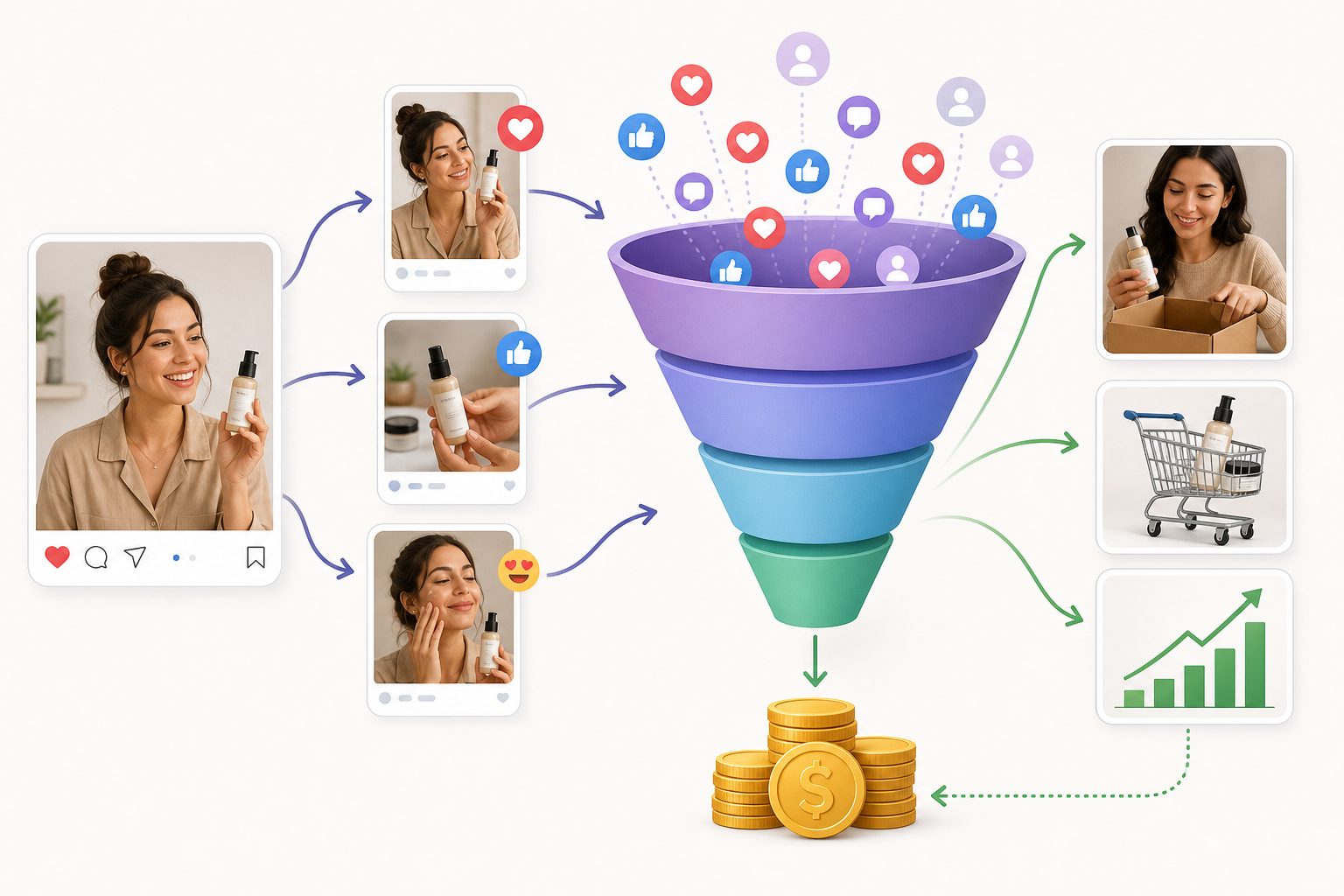
Likes, follower counts, and raw view numbers are easy to report but rarely correlate with business outcomes. The metrics that connect to revenue are engagement rate, click-through rate, conversion rate, cost per acquisition, and attributed sales. For shoppable content on TikTok Shop or Shopee, add live session revenue, add-to-cart rate, and checkout completion rate.
Engagement rate matters because it signals whether the audience is genuinely responding, not just scrolling past. A creator with a smaller but highly engaged following in a relevant niche will often outperform a larger creator whose audience is broad and passive. This is one reason why the distinction between influencers and KOLs matters when you are building a measurement framework: their audiences behave differently, and the metrics you prioritise should reflect that.
For UGC campaigns, also track content reuse: how many creator assets were repurposed as paid ads, and what was the performance lift compared to brand-produced creative.
Attribution methods and their practical trade-offs
No single attribution method is perfect. The most practical options for influencer campaigns are unique discount codes, UTM-tagged links, platform-native analytics, and brand lift studies.
Unique codes and UTM links are the simplest: each creator gets a trackable link or code, and conversions are assigned to that creator. The limitation is that they only capture clicks that happen immediately. A viewer who sees content, remembers it, and converts later through a direct search will not be captured.
Platform-native analytics on TikTok Shop and Shopee close some of that gap because the entire journey from content view to purchase happens inside the same app. Brand lift studies, which measure changes in aided awareness, purchase intent, or search volume before and after a campaign, are better suited to upper-funnel campaigns where direct conversion tracking is not the right measure. The right method depends on the campaign objective, not on which one produces the most flattering number.
Evaluating agency or campaign performance over time
A single campaign result tells you very little. The signal you want is trend: are cost-per-acquisition numbers improving, are the strongest-performing creators being retained, and is the content quality compounding? Agencies that report only on reach and impressions without connecting those numbers to conversion data are not giving you what you need to make decisions.
When evaluating an influencer marketing agency, ask specifically how they report on creator-level performance, what attribution methods they use, and whether they optimise mid-campaign or only report at the end. A performance-focused agency will adjust creator mix, content formats, and posting cadence based on real-time data rather than waiting for a post-campaign report.
For brands on TikTok Shop or Shopee, look for an agency with platform-specific expertise. Social commerce campaigns require understanding how in-app purchase behaviour differs from standard e-commerce, and a generic digital agency may not have the analytics access or platform knowledge to report on it accurately.
The brands that improve fastest are those that treat each campaign as a data-gathering exercise, not a one-off spend.
How to measure influencer marketing ROI step by step
-
Define the campaign objective first
Before selecting any metric, write down what the campaign is supposed to achieve: new customer acquisition, product launch awareness, direct sales, or content production for paid amplification. The objective determines the right metrics. A campaign designed to drive TikTok Shop purchases should be measured on attributed sales and cost per order, not on follower growth or impressions.
-
Set a baseline before the campaign runs
Measure your current brand search volume, website traffic from social referrals, and sales velocity before the campaign starts. Without a baseline, you cannot isolate the campaign's effect from seasonal trends or other marketing activity. A pre-campaign baseline is the single most overlooked step in influencer ROI measurement, and its absence is the main reason brands cannot prove whether a campaign worked.
-
Assign trackable links or codes to each creator
Give every creator a unique UTM-tagged link or discount code so you can attribute clicks and conversions at the individual level. For campaigns on TikTok Shop or Shopee, use the platform's built-in affiliate and analytics tools to track in-app purchase journeys. Creator-level tracking lets you identify your top performers and make data-driven decisions about who to work with again.
-
Track during the campaign, not just after
Monitor engagement rate, click-through rate, and early conversion signals within the first 48 to 72 hours of a post going live. For livestream commerce campaigns, track concurrent viewers, peak viewership, add-to-cart events, and live session revenue in real time. Mid-campaign data lets you reallocate budget toward creators or content formats that are outperforming, rather than waiting until it is too late to act.
-
Calculate ROI at the creator and programme level
For each creator, divide the attributed revenue by the total cost (creator fee plus production) to get a return ratio. At the programme level, compare total campaign spend against total attributed revenue, new customers acquired, and any measurable uplift in brand search volume. Report both numbers separately: a programme can show a positive overall return even when individual creators vary significantly, and knowing which ones underperformed is what drives improvement.
-
Review and apply learnings to the next campaign
Compile a post-campaign report that documents which creators, content formats, and posting times produced the strongest results. Feed those learnings directly into the brief for the next campaign. Influencer ROI compounds over time when brands treat each campaign as a data-gathering exercise: the brands that improve fastest are those that retain high-performing creators, refine their content strategy based on evidence, and increase spend on what is demonstrably working.
Benefits
Clarity on what actually drove sales
A structured ROI framework separates the creators and content formats that drove real conversions from those that generated only surface-level engagement. Attribution at the creator level makes that distinction visible and actionable.
Better creator selection over time
When you track performance by creator, you accumulate evidence about which audience profiles and content styles convert for your specific product. Retaining high-performing creators and replacing underperformers is only possible when you have the data to tell them apart.
Reduced wasted spend on vanity metrics
Shifting from impressions and follower counts to conversion-linked metrics means budget flows toward what is demonstrably working. Cost per acquisition and attributed revenue give you a basis for comparing influencer spend against other marketing channels.
Compounding returns from always-on programmes
Brands that apply campaign learnings consistently see improving ROI over successive campaigns as creator relationships deepen, content quality rises, and audience trust in the brand's products builds.
What ROI measurement looks like in practice
Beauty brand launching a new product on TikTok Shop
A beauty brand running a product launch campaign assigns each creator a unique TikTok Shop affiliate link and tracks add-to-cart rate, checkout completion, and attributed orders through the platform's native analytics. By comparing creator-level conversion rates, the brand identifies that mid-tier creators with a highly engaged skincare audience consistently outperform larger generalist creators on cost per order. That finding reshapes the creator brief for the next launch, concentrating spend on niche creators with demonstrated purchase intent in their audience.
Health supplement brand measuring upper-funnel impact
A health supplement brand running an awareness campaign cannot rely on direct conversion tracking because its customers typically research for weeks before buying. Instead, the brand measures uplift in branded search volume and tracks referral traffic from social platforms before and after the campaign window. It also surveys a sample of new customers at checkout, asking how they first heard about the brand. The combination of search data and survey responses gives a more complete picture than click attribution alone.
Overseas brand entering the Singapore market
A brand entering Singapore for the first time through Shopee runs a campaign with local KOL partners and needs to measure both sales velocity and brand awareness simultaneously. The team sets a pre-launch baseline for Shopee store visits and tracks weekly changes after creator content goes live. Cost per new customer acquired through the campaign becomes the primary KPI, allowing the brand to compare influencer-driven acquisition against other entry tactics and decide where to concentrate its local marketing budget.
E-commerce brand repurposing creator content as paid ads
An e-commerce brand commissions UGC from a set of creators with usage rights included, then runs the content as paid social ads alongside the organic influencer posts. The brand tracks performance separately for organic and paid placements, comparing click-through rate and cost per conversion between creator-produced content and its own brand-produced ads. Creator-led assets consistently outperform brand-produced creative in this scenario, and the performance data justifies a larger UGC content budget in subsequent quarters.
Common questions about measuring influencer marketing ROI
What is a good ROI benchmark for influencer marketing?
There is no universal benchmark because ROI varies significantly by industry, platform, campaign objective, and creator tier. The more useful question is whether your cost per acquisition through influencer marketing is competitive with your other acquisition channels, and whether it is improving over successive campaigns. Comparing your own results over time gives more actionable insight than comparing against industry averages.
How do I measure influencer ROI when there is no direct purchase link?
For campaigns where direct conversion tracking is not possible, combine branded search volume uplift, social referral traffic, and post-purchase surveys asking customers how they discovered the brand. Brand lift studies that measure changes in aided awareness and purchase intent before and after the campaign are another option for upper-funnel activity. No single method is complete; using two or three together gives a more reliable picture.
Should I measure ROI differently for TikTok Shop versus Shopee campaigns?
Both platforms offer native analytics that connect creator content to in-app purchases, but the specific metrics and tools differ. On TikTok Shop, affiliate link tracking and live session analytics provide granular creator-level data. On Shopee, store traffic and order attribution through the platform's seller tools serve a similar function. In both cases, the advantage over off-platform campaigns is that the full purchase journey happens inside the app, reducing the attribution gap.
How do I evaluate whether an influencer agency is delivering real ROI?
Ask the agency to show you creator-level performance data, not just blended campaign totals. A performance-focused agency should be able to tell you which creators drove the most conversions, what the cost per acquisition was by creator, and how results changed over the course of the campaign. Agencies that report only on reach and impressions without connecting those numbers to revenue are not giving you what you need to make informed decisions.
Ready to measure what your influencer campaigns actually deliver
If you are running influencer or KOL campaigns and want clearer visibility into what is actually driving revenue, Confetti builds and manages performance-driven creator programmes with ROI measurement built in from the start. Reach out to discuss how a structured approach to tracking and attribution can improve results for your next campaign.