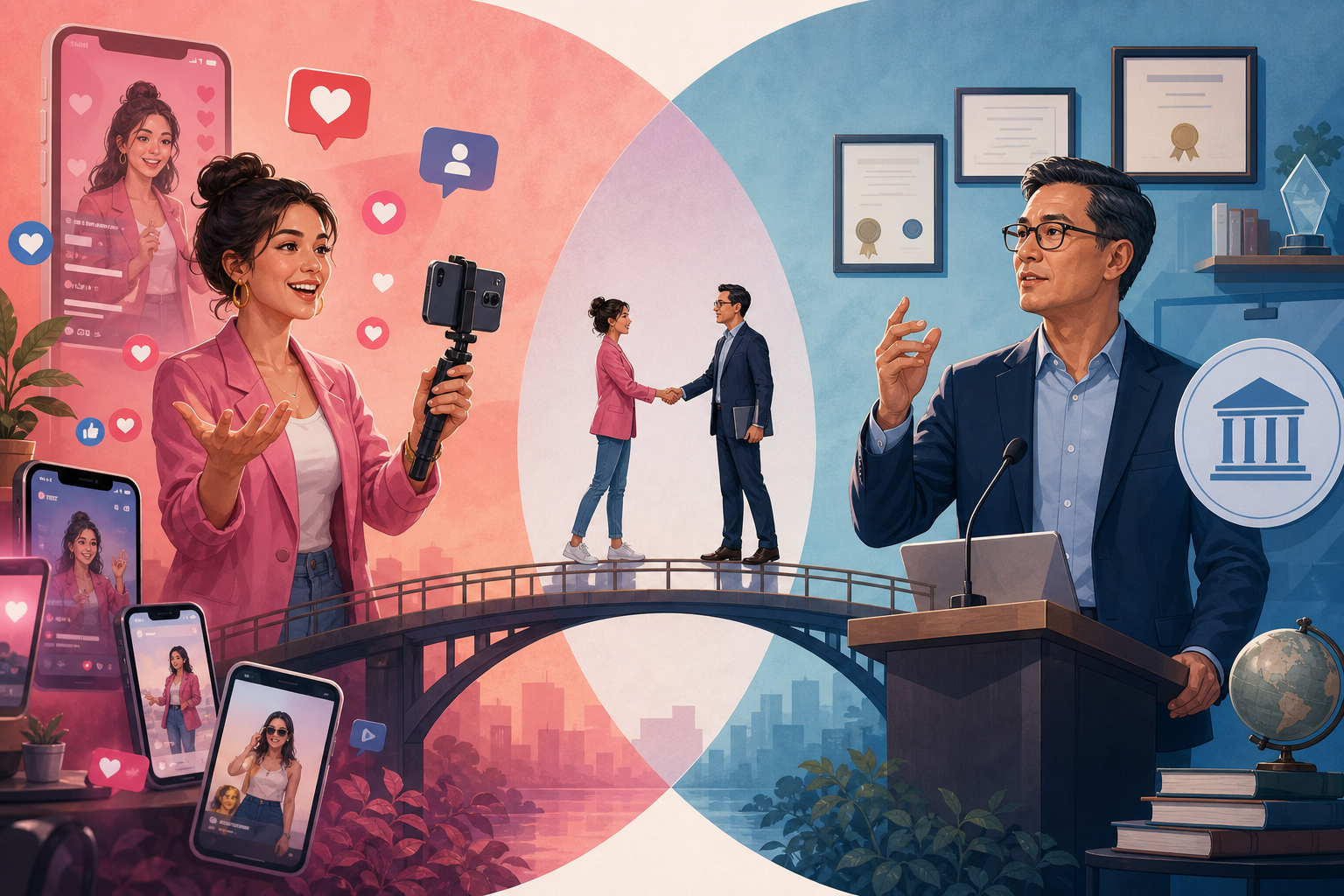
Two different types of trusted voices, two different roles in your marketing mix. Here is how to tell them apart and deploy each one effectively.
Match the right voice to the right campaign goal
Find the right creator type for your next campaign and build a strategy that converts.
Where the confusion between the two comes from
Both influencers and KOLs are paid or partnered to speak about a brand to an audience that trusts them. That surface similarity is why the terms get used interchangeably in briefs, budgets, and agency decks. But the source of their authority is fundamentally different, and treating them as substitutes for each other is one of the most common mistakes in creator marketing.
An influencer builds their following through content creation: lifestyle posts, reviews, tutorials, and entertainment on platforms such as TikTok, Instagram, or Lemon8. Their value to a brand is rooted in reach, relatability, and engagement rate. A KOL (Key Opinion Leader) earns authority through professional expertise or peer recognition in a specific field, whether that is dermatology, personal finance, fitness science, or culinary arts. Their credibility exists independently of any platform algorithm.
What makes a KOL different from an influencer
The clearest way to distinguish them is to ask: would this person's opinion still carry weight if they had no social media presence? For a KOL, the answer is usually yes. A cardiologist recommending a supplement, a certified financial planner reviewing an investment app, or a Michelin-trained chef endorsing a kitchen brand all have authority that predates their follower count.
For an influencer, the platform is the credential. Their value is inseparable from their audience, their content style, and their engagement metrics. That is not a weakness; it is simply a different kind of trust. Audiences follow influencers because they find them entertaining, aspirational, or relatable, not because of a professional qualification. You can read a deeper breakdown of what KOLs are and why they matter if you want to explore the KOL side of this in more detail.
When to use an influencer versus a KOL
The decision comes down to your campaign objective and your audience's decision-making process. Influencers are well suited to awareness, discovery, and top-of-funnel reach: launching a new product, entering a new demographic, or generating a volume of content across social feeds. Their strength is scale and authenticity at speed.
KOLs are better deployed when the purchase decision requires trust in expertise. A health supplement brand trying to reach fitness professionals, a skincare brand seeking dermatologist endorsement, or a fintech product targeting investors will find that a KOL's professional credibility does work that a lifestyle influencer cannot. Platforms such as Xiaohongshu sit interestingly between the two, hosting both expert-led content and lifestyle creators, which is part of why brands use it for nuanced audience targeting.
How the two complement each other in a single campaign
The most effective campaigns do not choose one or the other; they sequence them. A KOL provides the authoritative endorsement that gives a product credibility, and influencers then amplify that message to a broader audience at scale. Think of it as a credibility layer and a reach layer working in tandem.
For example, a beauty brand might partner with a dermatologist (KOL) to validate a skincare formula, then brief a set of lifestyle creators (influencers) to show how the product fits into a daily routine. The KOL content anchors the claim; the influencer content makes it shareable and discoverable. This structure is particularly effective in social commerce environments such as TikTok Shop, where both trust and entertainment drive conversion. Confetti's KOL marketing services and influencer marketing services are built around this kind of layered approach.
Practical considerations before you brief either type
Before briefing a creator, be clear about three things: the campaign objective, the audience's trust triggers, and the content format. Influencers need a clear content brief that respects their voice; over-scripted influencer content tends to underperform because it loses the authenticity audiences follow them for. KOLs need to understand the product's claims and evidence, because their reputation depends on only endorsing what they can stand behind professionally.
Usage rights and exclusivity are also handled differently. Influencer content is often repurposed as UGC across paid social, which requires explicit licensing agreements. KOL endorsements may carry restrictions around competing brands or professional association guidelines. Getting these details right before contracting either type protects both the brand and the creator. If UGC content strategy is part of your plan, this overview of UGC creation covers what to build into your brief.
Reach without credibility is noise; credibility without reach is a whisper. The strongest campaigns find a way to deliver both.
How to build a strategy that uses both effectively
-
Define your objective and trust requirement
Start by asking what the campaign needs to do and what kind of trust will move your target audience. If the goal is awareness and discovery among a broad consumer segment, influencers are likely your primary vehicle. If the goal is to persuade a skeptical or professional audience, or to substantiate a product claim, a KOL is the more appropriate choice. Clarity on this single question shapes every decision that follows, from creator selection to content format.
-
Map creator type to campaign stage
KOLs tend to perform best at the consideration and credibility stage, where a buyer is evaluating whether a product actually does what it claims. Influencers tend to perform best at the awareness and conversion stages, where reach, entertainment, and social proof drive action. Mapping creator type to funnel stage rather than treating them as interchangeable prevents budget being spent on the wrong voice at the wrong moment.
-
Select creators based on audience alignment, not just size
For influencers, look at engagement rate, audience demographics, and content niche. A creator with a smaller but highly engaged audience in your product category will typically outperform a larger general-interest account. For KOLs, assess professional credentials, peer recognition, and whether their domain genuinely overlaps with your product's benefit claims. You can explore how KOLs drive sales for brands for a more detailed look at what makes a KOL selection effective.
-
Brief each creator type differently
Influencer briefs should set the objective, key message, and any mandatory inclusions (such as a product claim or a call to action), then leave creative latitude. Restricting an influencer's voice reduces the authenticity that makes their content work. KOL briefs should include product evidence, claim boundaries, and any professional or regulatory context they need to endorse the product responsibly. Treating both briefs identically is one of the most common execution errors in multi-creator campaigns.
-
Layer KOL credibility with influencer reach
Where budget allows, sequence your activations: publish KOL content first to establish credibility, then activate influencer content to amplify reach. This sequencing means the influencer audience encounters a product that already has authoritative backing, which strengthens conversion. In social commerce contexts such as Shopee livestream campaigns, this layered approach can directly lift conversion rates during a live selling event.
-
Measure each creator type against the right metrics
Influencer performance is typically measured by reach, engagement, click-through, and conversion. KOL performance is better assessed by sentiment shift, share of voice in professional communities, and downstream impact on credibility metrics or search behaviour. Applying engagement rate as the sole metric to a KOL campaign will consistently undervalue its contribution. Set separate KPIs for each creator type from the outset.
Benefits
Clearer creator selection decisions
Understanding the distinction means you brief the right creator type for each objective, rather than defaulting to whoever has the largest following. Matching creator authority to audience trust triggers is what separates campaigns that convert from those that generate impressions only.
Better budget allocation across the funnel
Knowing when to invest in KOL credibility versus influencer reach lets you distribute budget according to where it will have the most impact at each funnel stage. Spending KOL budget on awareness, or influencer budget on credibility-dependent decisions, is a common and avoidable misallocation.
Stronger campaign outcomes through sequencing
Layering KOL endorsement with influencer amplification produces a campaign that is both trustworthy and discoverable. The two creator types reinforce each other: credibility established by a KOL makes influencer content more persuasive, not just more visible.
Reduced risk of creator-brand mismatch
A KOL who endorses a product outside their professional domain loses credibility, and so does the brand. An influencer given an over-scripted brief loses authenticity. Understanding each type's operating conditions helps you brief and contract them in ways that protect both the creator's reputation and the campaign's effectiveness.
When each approach makes the most sense
Health supplement brand entering Singapore
A health supplement brand launching in Singapore needs to overcome consumer skepticism about efficacy claims. Partnering with a certified nutritionist or sports scientist as a KOL establishes the product's credibility with health-conscious buyers who research before purchasing. Once the KOL content is live, lifestyle fitness influencers can amplify the message to a broader audience, showing the product in everyday training routines. The KOL provides the 'why it works'; the influencers provide the 'how I use it'. This mirrors the kind of layered campaign structure that Confetti applies across health and wellness brands.
Beauty brand validating a skincare formula
A skincare brand with a new active ingredient needs more than reach; it needs a credible voice to explain what the ingredient does and why it matters. A dermatologist or cosmetic chemist KOL can do this in a way that a lifestyle influencer cannot, because the claim requires professional authority to be believable. Influencer content then takes that validated claim and translates it into relatable, shareable formats: morning routine videos, before-and-after content, and product tutorials. Platforms such as Xiaohongshu are particularly well suited to this combination, as the audience actively seeks both expert advice and peer recommendations.
Fintech product targeting retail investors
A financial services brand launching a retail investment product faces a high-trust barrier. Lifestyle influencers alone are unlikely to move a cautious audience toward a financial decision. A KOL with a background in personal finance or investment analysis, who has earned credibility through professional content over time, is far better positioned to speak to the product's value proposition. The KOL's endorsement signals that the product has passed a credible professional's scrutiny, which is the trust trigger this audience needs. Confetti has worked with brands in financial services, including Bybit, applying this kind of credibility-first creator strategy.
Consumer goods brand running a TikTok Shop launch
A consumer goods brand launching on TikTok Shop primarily needs reach, content volume, and conversion at the point of sale. Here, influencers are the core vehicle: multiple creators producing short video content and participating in livestream selling events drives discovery and in-session purchases. A KOL may still play a role, perhaps as a guest on a livestream to lend authority to a product category, but the campaign's engine is influencer-driven. This is the model Confetti uses across social commerce creator campaigns, where content volume and platform-native formats determine results.
Common questions about influencers vs KOLs
Can the same person be both a KOL and an influencer?
Yes, and this overlap is increasingly common. A fitness professional who has built a large social media following is both a credentialed expert (KOL) and a platform creator (influencer). When this overlap exists, the creator offers both reach and professional authority, which makes them particularly valuable but also typically more expensive to partner with. The key is to understand which dimension of their identity is doing the work for your specific campaign.
Does follower count determine whether someone is a KOL or an influencer?
No. Follower count is a metric of platform reach, not professional authority. A KOL may have a modest social media following but carry significant weight within a professional community, such as a respected academic, a specialist physician, or an industry analyst. Conversely, a large-following influencer may have no domain expertise at all. The source of credibility, not the size of the audience, is what distinguishes a KOL from an influencer.
How do I decide which type to prioritise with a limited budget?
Start with your audience's decision-making process. If your target buyer makes decisions based on peer recommendation, lifestyle aspiration, or social proof, influencers will deliver more value per dollar. If the decision requires professional validation or the product makes a specific efficacy claim, a KOL is the higher-priority investment even at a smaller scale. When budget is tight, one well-matched KOL paired with a small group of relevant influencers often outperforms a large influencer roster with no credibility anchor.
What does working with KOLs and influencers look like in practice for a Singapore brand?
In Singapore's social commerce environment, brands typically work with influencers across TikTok, Instagram, and platforms such as Lemon8 for content volume and reach, while engaging KOLs for category-specific credibility, particularly in health, beauty, finance, and food. Agencies such as Confetti manage both types within a single campaign framework, handling creator sourcing, briefing, content review, and performance measurement across KOL campaigns and broader influencer marketing programmes.
Build a creator strategy that balances reach and credibility
If you are planning a campaign that needs both reach and credibility, the creator mix matters as much as the brief. Confetti works with brands across Singapore to identify the right KOLs and influencers for each objective, manage the full campaign workflow, and measure what actually converts. Speak with the team about building a creator strategy that fits your goals.