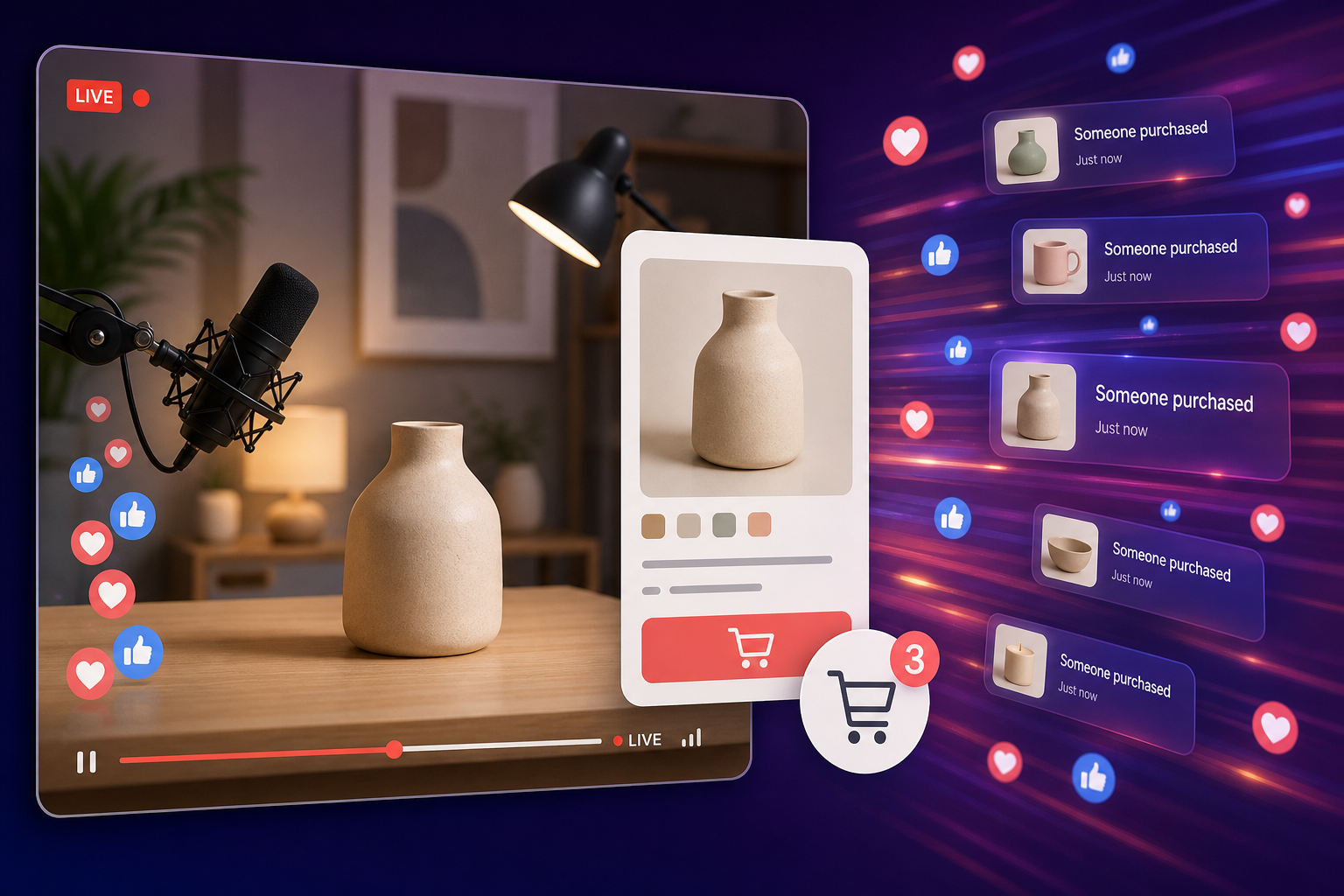
How to combine real-time video with direct purchasing to turn viewers into buyers and grow revenue beyond a single broadcast.
Run livestream campaigns that drive real sales
Explore how Confetti plans and produces livestream commerce campaigns that convert.
What livestream e-commerce actually is
Livestream e-commerce merges real-time video broadcasting with native purchasing functionality, so a viewer can watch a product being demonstrated, ask a question in the comments, and complete a purchase without ever leaving the stream. The format is distinct from a standard product page or a pre-recorded video ad because the interaction is live: the host can respond to objections instantly, show the product from different angles on request, and create time-limited offers that expire when the broadcast ends. That combination of immediacy and interactivity is what drives conversion rates that consistently outperform static online retail. Platforms such as TikTok Shop and Shopee have built this purchasing layer directly into their apps, making the checkout flow seamless for buyers already browsing social content. For brands, the practical result is a sales channel where entertainment and transaction happen in the same moment.
Choosing the platform that fits your audience
Not every platform suits every brand. TikTok Shop draws a discovery-oriented audience that responds well to entertainment-led selling, short demos, and creator-hosted shows. Shopee attracts buyers who are already in a shopping mindset, making it well suited to brands with an established presence on the marketplace. The right choice depends on where your target customers already spend time and where your product category performs. A beauty brand targeting younger consumers in Singapore may find TikTok Shop Live the stronger fit, while a home goods brand with an existing Shopee store might build on Shopee livestream commerce first. Some brands run both simultaneously once they have the production capacity. Platform selection also determines which analytics you can access, which creator networks you can tap, and what checkout integrations are available, so it is worth evaluating before investing in production infrastructure.
The host is the product's most important asset
A livestream lives or dies on the person presenting. The host needs deep product knowledge so they can answer questions accurately under pressure, and they need on-camera presence strong enough to hold attention across a broadcast that may run for an hour or more. These two qualities rarely come together by accident. Brands that invest in proper host briefing, scripted talking points for key product claims, and rehearsal time before going live consistently outperform those that wing it. Many brands work with KOLs or influencers as hosts precisely because they bring an existing audience and a natural on-camera manner. The trade-off is that an external host needs thorough onboarding so their product claims are accurate. Whether the host is internal staff or a creator partner, the investment in preparation is not optional: it is the single biggest lever on conversion.
Checkout friction kills conversion at the final step
A viewer who decides to buy during a livestream will abandon the purchase if the checkout process is slow, confusing, or requires leaving the platform. Reducing drop-off at checkout is one of the most practical levers brands overlook when planning their first live show. On TikTok Shop and Shopee, the native checkout is embedded in the stream, which eliminates the redirect problem. But brands still need to ensure that product listings are correctly linked to the stream before going live, that stock levels are accurate, and that any promotional pricing or bundle offers are pre-configured in the platform rather than announced verbally without a corresponding cart option. A viewer who hears "add it to cart now" and cannot find the product in the stream's product tray will not wait. They will move on. Testing the full purchase flow from a viewer's device before every broadcast is a basic quality check that prevents avoidable revenue loss.
Replay content extends the revenue window
The broadcast itself is not the end of the revenue opportunity. Replay content, the recorded version of a live show, continues to attract viewers and generate purchases after the stream ends. This matters because many potential buyers are not watching live: they discover the content in their feed hours or days later. Brands that treat the replay as a secondary asset, leaving it unedited and unoptimised, leave revenue on the table. Clipping the highest-performing segments into short-form video for organic distribution, or using them as UGC-style content in paid campaigns, extends the reach of a single broadcast significantly. The live show becomes the source material for a content engine rather than a one-time event. This approach also provides data: viewing patterns in replays reveal which product segments held attention and which caused drop-off, informing the structure of the next live show.
The gap between watching and buying collapses when a host can answer a question and close a sale in the same breath.
How to build a livestream commerce show from scratch
-
Define the show format and goal
Before any production decisions, establish what success looks like for a single broadcast: a revenue target, a number of units sold, or a new-audience reach figure. Then decide on the show format. A product launch show has a different structure than a weekly deals show or a creator-hosted review session. Matching the format to the goal prevents you from building a show that entertains without converting, or converts a small audience without building the repeat viewership that makes the channel sustainable.
-
Select and brief your host
Choose a host based on product fit and audience alignment, not just follower count. If you are using a creator or KOL, ensure they have reviewed the product, understand the key claims, and know which questions they are likely to face live. Prepare a run sheet that sequences product segments, scripted key messages, and planned interaction moments (polls, comment questions, giveaway announcements). A host who is well-briefed can improvise naturally within a clear structure, which is what live selling requires.
-
Set up the production environment
Production quality does not need to be broadcast-level, but it must be consistent. Stable lighting, clear audio, and a reliable internet connection are non-negotiable. A dropped stream mid-show or an inaudible host costs more in lost sales than any studio investment. Decide whether you are broadcasting from a brand studio, a creator's own space, or a managed production setup. Ensure the platform account is correctly configured, products are pinned in the stream tray, and promotional mechanics (discount codes, bundle offers) are live in the system before the broadcast starts.
-
Drive pre-show traffic
A live show with no audience at the start is hard to recover. Pre-show promotion across owned channels (social posts, email, Stories) in the days before broadcast builds a scheduled audience. On TikTok Shop and Shopee, you can also schedule the show in advance so it appears in discovery feeds. Creator partners can promote the upcoming show to their own audiences. The goal is to ensure a critical mass of viewers is present in the first few minutes, because early engagement signals the algorithm to distribute the stream more broadly.
-
Run the show with active comment management
During the broadcast, someone other than the host should be monitoring comments in real time. This person surfaces genuine product questions for the host to answer, filters out noise, and manages giveaway or promotion mechanics. The host cannot read a comment feed and maintain eye contact with the camera simultaneously. A dedicated comment moderator is a production role that directly affects conversion: unanswered questions become unanswered objections, and objections become abandoned carts.
-
Analyse, clip, and redistribute
After the broadcast, pull the platform analytics to understand peak viewership moments, product click-through rates, and conversion by segment. Identify the two or three product segments that performed best and clip them into short-form video for redistribution. Use replay data to refine the run sheet for the next show. This feedback loop is what separates a brand that runs occasional live shows from one that builds a social commerce channel with compounding reach and improving conversion over time.
Benefits
Higher conversion than static pages
Live product demonstration combined with instant Q&A removes the hesitation that causes drop-off on standard product pages. The ability to answer objections in real time closes the gap between interest and purchase in a way that images and descriptions cannot.
Urgency that is built into the format
Time-limited offers and live-only pricing create genuine purchase urgency without requiring artificial pressure tactics. The broadcast window itself is the constraint, and viewers understand that.
Revenue beyond the live window
Replay content and clipped short-form video extend the sales period of a single broadcast. A well-structured show becomes source material for a content engine that keeps generating traffic and conversions after the stream ends.
Direct audience feedback in real time
Comment activity during a livestream reveals which product claims resonate, which questions repeat, and which segments lose attention. This live feedback loop is more immediate than any post-campaign survey and directly improves the next show.
Platform algorithm amplification
On TikTok Shop and Shopee, active livestreams with strong engagement are surfaced to new audiences by the platform algorithm, providing organic reach that supplements any paid promotion driving viewers to the show.
Livestream commerce in practice
Beauty brand launching a new product line
A beauty brand releasing a new skincare range uses a livestream to demonstrate texture, application technique, and before-and-after results in real time, something a product page photograph cannot replicate. A creator host with an existing beauty audience brings credibility and a warm viewership from the first minute. Live Q&A segments address ingredient questions that would otherwise become pre-purchase research detours, keeping buyers in the stream through to checkout. The replay is clipped into short demos for paid social, extending the campaign beyond the broadcast date.
Health supplement brand building repeat purchase behaviour
A health supplement brand uses a weekly livestream show to educate viewers on usage, stack combinations, and results, building a regular audience that returns each week. The format suits supplements well because trust and education drive conversion more than impulse in this category. Returning viewers convert at higher rates than first-time viewers, so consistency in the show schedule compounds results over time. Exclusive bundle offers available only during the live show give existing customers a reason to tune in rather than simply reordering through the standard product page.
Overseas brand entering the Singapore market
A brand expanding into Singapore from another market uses livestream commerce as a faster route to local credibility than building organic social presence from scratch. Partnering with a local KOL or creator as the show host provides immediate audience access and cultural relevance. The live format also surfaces localised objections (questions about local shipping, product suitability for the climate, local regulatory compliance) that the brand can address in real time, accelerating the trust-building that normally takes months of content marketing.
Footwear brand running a flash-sale show
A footwear brand uses a time-limited livestream sale to clear end-of-season inventory without discounting across all channels. The show features a host trying on styles, sharing fit notes, and revealing deal prices only during the broadcast window. Scarcity mechanics (limited sizes, countdown timers visible in the stream) create genuine urgency without manufactured pressure. Post-show analytics identify which styles generated the most cart activity, informing both the next sale show and the brand's standard product ranking on the marketplace.
Livestream e-commerce questions answered
How long should a livestream commerce show be?
There is no universal answer, but the format rewards consistency over length. A show long enough to cover multiple product segments, allow genuine Q&A, and run at least one promotional moment gives the algorithm enough engagement signal to distribute the stream. Brands new to livestream commerce often start with a focused show of moderate length and extend duration as their audience and host confidence grow. Reviewing replay drop-off data after each show is the most reliable way to calibrate the right length for your specific audience.
Do I need a professional studio to run a livestream?
Not necessarily. Stable lighting, clear audio, and a reliable internet connection matter far more than broadcast-level production. Many successful livestream shows are produced from a brand's own space or a creator's studio. What viewers penalise is poor audio or a dropped stream, not a simple background. As show frequency and revenue grow, investing in a dedicated production setup becomes worthwhile, but it is not a prerequisite for starting.
Should I use my own staff or a creator as the host?
Both approaches work, and the right choice depends on your goals. An internal host has deep product knowledge and represents the brand directly, but may lack an existing audience. A creator or KOL host brings their own viewership and on-camera experience, but requires thorough product briefing to ensure accuracy. Many brands combine both: a creator hosts for audience reach while a brand team member joins to handle technical product questions.
How do I measure whether a livestream show is working?
The core metrics are concurrent viewership, product click-through rate during the stream, conversion rate from click to purchase, and total revenue per broadcast. Replay views and post-show conversion from replay content are also worth tracking. Comparing these figures across shows over time reveals which formats, hosts, and product sequences drive the best results, and gives you the data to improve each successive broadcast rather than repeating the same show structure indefinitely.
Build a live selling channel that grows with every show
Confetti plans, produces, and manages livestream commerce campaigns on TikTok Shop and Shopee, covering everything from host selection and scripting to studio setup and post-show analytics. If you want to build a live selling channel that compounds results over time, speak with the team about what a campaign could look like for your brand.