A practical guide to how livestream commerce works, what makes it convert, and how to run it effectively.
Run livestream campaigns that convert viewers into buyers
Explore how Confetti runs full-production livestream campaigns that drive measurable sales on TikTok Shop and Shopee.
What livestream shopping actually is
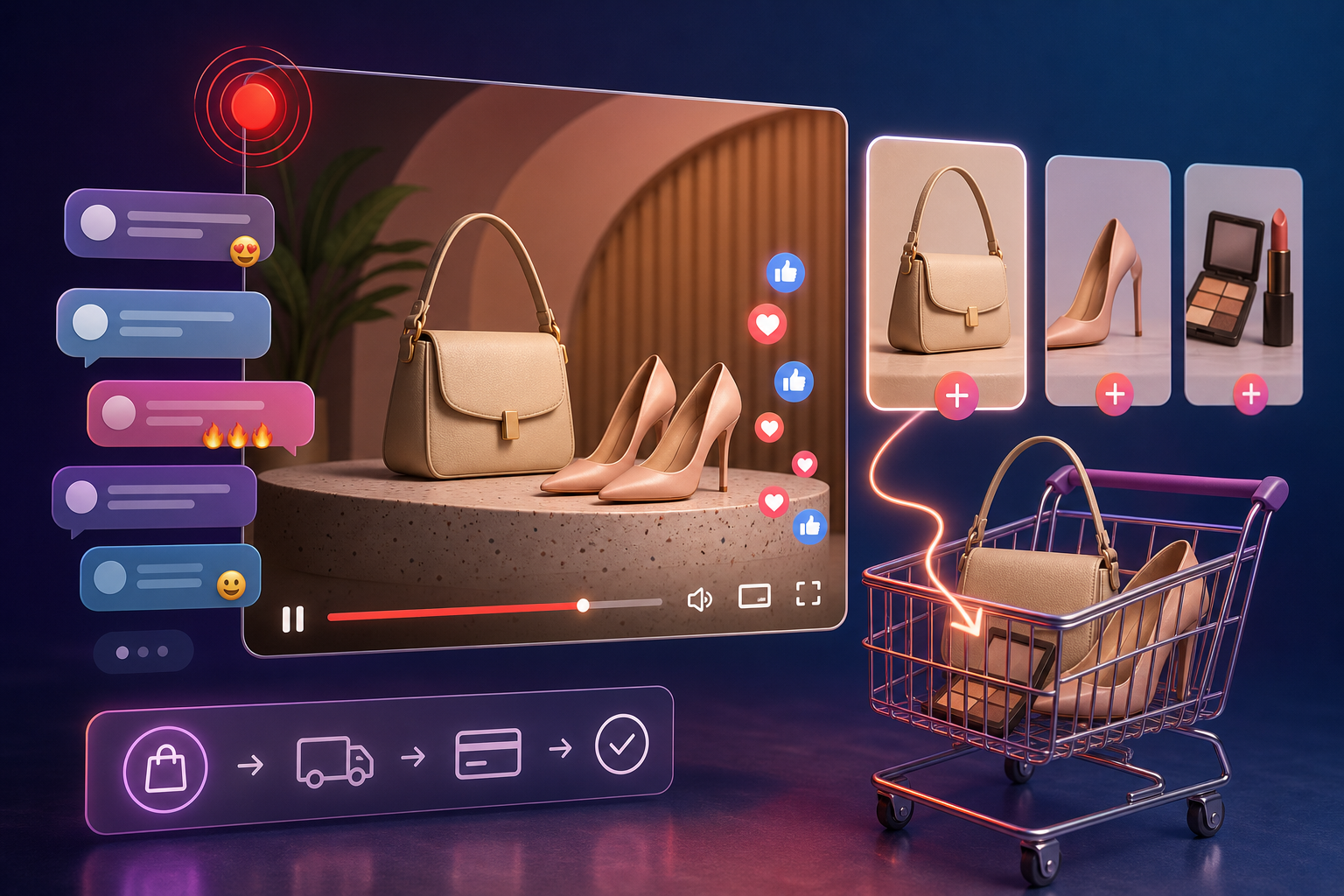
Livestream shopping is real-time video broadcasting combined with direct e-commerce, so that viewers can buy products without leaving the stream. A host, whether a brand employee, a KOL, or a creator, demonstrates products on camera while embedded links, in-chat prompts, or integrated checkout buttons let viewers purchase instantly. The format is not simply a product video with a link underneath. The purchase happens inside or alongside the live broadcast itself, which collapses the gap between product discovery and transaction. Platforms like TikTok Shop and Shopee have built this infrastructure natively, making it straightforward for brands to run shoppable streams without external tools. For a deeper look at how TikTok Shop's commerce layer works, see how TikTok Shop works for brands.
The mechanics that make a live sale happen
Three elements have to work together for a livestream to convert: the content, the interaction, and the checkout integration. On the content side, product demonstrations performed live carry more credibility than edited video because viewers can see the product in real conditions and ask questions in real time. On the interaction side, live Q&A and comment responses address purchase objections as they arise, which is something a static product page cannot do. On the checkout side, the platform must connect the stream to a shopping cart or payment system so that tapping a pinned product link completes a purchase without redirecting to a separate browser tab. Urgency mechanics, such as limited-time offers or exclusive drops surfaced during the stream, layer on top of this to accelerate decisions. Social commerce creator marketing strategies often combine all three elements in a single session.
Hosted brand streams versus creator-led affiliate streams
There are two main models brands use. In a hosted brand stream, the brand controls the broadcast entirely: it sets the script, the offers, and the presenter, and all revenue flows directly to the brand's store. This model suits product launches, seasonal sales events, or any situation where brand consistency matters most. In a creator-led affiliate stream, an independent KOL or influencer hosts the session from their own account, promoting the brand's products to their existing audience and earning a commission on sales. The creator's established trust with their followers is the primary conversion driver here. Many brands run both in parallel, using brand streams for control and creator streams for reach. Understanding the difference between KOLs and influencers helps clarify which type of creator suits which stream format.
Why audience interaction is a conversion tool
Live comments are not background noise. A viewer who types "does this work on sensitive skin?" and receives an on-camera answer within seconds has had a sales objection resolved in real time. This interactive loop between host and viewer is what separates livestream commerce from pre-recorded video or display advertising. Skilled hosts monitor the comment feed continuously, surface the most common questions, and use them to guide the product demonstration. Platforms reward this engagement too: higher comment and interaction rates typically push a live broadcast to more viewers within the platform's algorithm. The result is that good hosting is itself a growth mechanism, not just a production consideration. KOL influence and why it outperforms traditional advertising explores this trust dynamic in more depth.
What brands need in place before going live
A successful livestream sale requires preparation across four areas. First, platform integration: the brand's product listings must be connected to the streaming environment so that pinned links resolve to a working checkout. Second, inventory: stock levels need to match anticipated demand, particularly if limited-time offers are planned. Third, the host: whether an in-house presenter or an external KOL, the person on camera needs to know the product range, be comfortable with live Q&A, and understand how to surface offers at the right moment. Fourth, production: lighting, audio, and a clean background matter more than many brands expect, because poor production quality undermines the credibility the format is meant to build. Agencies that specialise in Shopee livestream commerce typically handle scripting, studio setup, and host briefing as part of a managed service.
When a host answers a viewer's question live and links directly to the product in the same breath, the gap between discovery and purchase collapses.
How a livestream shopping session works, step by step
-
Set up the shoppable product catalogue
Before going live, the brand connects its product listings to the platform's livestream commerce layer. On TikTok Shop or Shopee, this means ensuring each SKU has an approved listing, accurate inventory, and a thumbnail that renders clearly as a pinned card during the broadcast. Getting the catalogue right before the stream starts prevents the most common technical failure: a host pinning a product only to find the link is broken or out of stock mid-session.
-
Plan the session script and offer sequence
A livestream is not an improvised demo. The host works from a structured run-of-show that sequences product introductions, talking points, Q&A windows, and offer reveals. Urgency mechanics, such as a limited-quantity bundle or a time-capped discount, are scripted at specific points in the session rather than introduced randomly. This structure keeps the stream moving and ensures every product gets adequate screen time without the session running flat.
-
Go live and pin products as they are featured
Once the broadcast starts, the host (or a co-host managing the backend) pins the relevant product card to the stream as each item is introduced. Viewers see a tappable product link overlaid on the video. Pinning the product at the moment it is being demonstrated, rather than leaving a static list, creates a direct visual connection between what the host is showing and what the viewer can buy. Comment moderation runs in parallel to surface viewer questions for the host.
-
Respond to live comments and address objections
The comment feed is the primary interaction channel. A dedicated moderator, or the host directly on smaller streams, reads comments aloud and answers questions on camera. Handling objections live, such as questions about sizing, ingredients, or compatibility, converts hesitant viewers who would otherwise leave the stream without purchasing. This is the mechanic that most distinguishes livestream commerce from a standard product video.
-
Close with a clear call to action and replay plan
As the session ends, the host directs viewers to complete any pending purchases before the stream closes and any session-specific offers expire. The recorded stream is then repurposed as on-demand content, extending its reach beyond the live audience. Short clips from the session can be redistributed as short-form video ads or UGC-style content to drive traffic back to the product listings.
-
Analyse performance and iterate
After the session, the brand reviews peak viewer count, average watch time, product click-through rates, and conversion rates by SKU. The gap between click-through and conversion often reveals whether the issue is pricing, host presentation, or checkout friction rather than audience reach. These insights directly inform the next session's script, product selection, and offer structure, making each stream more effective than the last.
Benefits
Purchase happens inside the stream
Integrated checkout removes the redirect step that causes drop-off in traditional e-commerce funnels. Viewers tap a pinned product card and complete the purchase without leaving the broadcast.
Live Q&A resolves objections in real time
A host who answers viewer questions on camera addresses the doubts that prevent purchase. This interactive objection handling converts hesitant viewers in a way that static product pages or pre-recorded video cannot replicate.
Urgency mechanics accelerate decisions
Limited-time offers and exclusive drops, surfaced at scripted moments during the session, create time-bound purchase pressure that shortens the decision cycle without requiring external advertising spend.
Creator credibility transfers to the product
When a trusted KOL or influencer hosts the stream, their existing audience relationship lends credibility to the product demonstration. This trust transfer is the core conversion mechanism in creator-led affiliate streams and is difficult to replicate through brand-only channels.
Performance is directly attributable
Unlike brand awareness campaigns, livestream commerce generates SKU-level sales data tied directly to the session: click-through rates, conversion rates, and revenue per product are visible immediately after the broadcast.
Livestream shopping in practice: real scenarios
A beauty brand launching a new skincare line
A beauty brand preparing to launch a new serum range uses a creator-led affiliate stream to reach an established audience. A skincare KOL hosts the session from their own TikTok account, applying the product on camera and answering viewer questions about skin type compatibility in real time. The combination of live demonstration and trusted host credibility addresses the primary purchase barrier for skincare: uncertainty about how the product will perform on different skin. Sales are tracked by SKU through the platform's affiliate commission system, giving the brand clear attribution data. For more on how KOLs drive sales for brands, the linked guide goes deeper.
A consumer goods brand running a seasonal sale event
A household goods brand schedules a brand-hosted stream on Shopee to coincide with a major shopping festival. The brand's own presenter works through a scripted sequence of product bundles, each pinned and featured for a fixed window before the next is introduced. Limited-quantity bundle offers, revealed at specific points in the session, create the purchase urgency that drives conversion spikes during the broadcast. The brand controls the entire experience, including pricing, offer sequencing, and brand messaging, without relying on an external creator. Shopee livestream commerce campaigns are built around exactly this kind of structured sale event.
An overseas brand entering the Singapore market
A brand from China looking to establish itself in Singapore uses livestream commerce as an early-market activation tool. Rather than building an audience from scratch, the brand partners with local KOLs who already have credibility with Singapore consumers. Local creators hosting the stream in the audience's language and cultural register removes the unfamiliarity barrier that often slows market entry. The brand's products are listed on TikTok Shop Singapore, and the creator's affiliate links drive traffic directly to the local storefront. This approach generates both initial sales and early social proof for the brand's new market presence.
A health supplement brand building ongoing purchase frequency
A health supplement brand uses a recurring weekly livestream, hosted by a consistent presenter, to build habitual viewership. Regular viewers return for product updates, Q&A sessions, and member-exclusive offers surfaced during the stream. Consistency of host and schedule builds the kind of audience familiarity that drives repeat purchase rather than one-off transactions. This model functions less like a single campaign and more like an always-on influencer marketing programme anchored to a live commerce format.
Livestream shopping explained: common questions
What is the difference between a brand-hosted stream and a creator-led stream?
In a brand-hosted stream, the brand controls the broadcast, the presenter, the offers, and the messaging, and all sales flow to the brand's own store. In a creator-led affiliate stream, an independent KOL or influencer hosts from their own account, promoting the brand's products to their existing audience and earning a commission on resulting sales. The two models serve different goals: brand streams prioritise control and consistency, while creator streams prioritise reach and the host's established audience trust.
Which platforms support native livestream shopping in Singapore?
TikTok Shop and Shopee both offer native livestream commerce infrastructure in Singapore, meaning product listings, pinned product cards, and checkout are integrated directly into the streaming environment. Brands selling on either platform can run shoppable streams without requiring external tools, provided their product catalogue is correctly set up and approved on the platform.
How does audience interaction during a livestream actually drive sales?
Viewer comments function as a live objection-handling channel. When a host reads a question from the comment feed and answers it on camera, they resolve a purchase barrier for every viewer who had the same doubt but did not type it. This real-time resolution of objections is the primary mechanism by which livestream commerce converts at higher rates than pre-recorded content or static product listings. Skilled hosts and dedicated comment moderators are both important to making this work at scale.
Do brands need a production studio to run a successful livestream?
Not necessarily. Many effective streams are run from a clean, well-lit space rather than a full studio. What matters most is stable lighting, clear audio, and a background that does not distract from the product. That said, production quality does affect perceived credibility, and brands running high-frequency or high-stakes sessions often invest in a dedicated setup or work with an agency that provides studio facilities as part of a managed service.
How should a brand measure whether a livestream session performed well?
The most direct metrics are SKU-level conversion rate (how many viewers who clicked a pinned product actually completed a purchase) and revenue per session. Supporting metrics include peak concurrent viewers, average watch time, and comment volume, which indicate engagement quality. The gap between click-through rate and conversion rate is particularly diagnostic: a high click-through but low conversion often points to a checkout friction issue or a pricing mismatch rather than a content problem.
Turn your next live session into a measurable sales event
Livestream commerce works best when content strategy, host selection, and platform integration are planned together rather than assembled at the last minute. If you want to understand how a managed livestream programme could work for your brand on TikTok Shop or Shopee, Confetti's team can walk you through the options.