
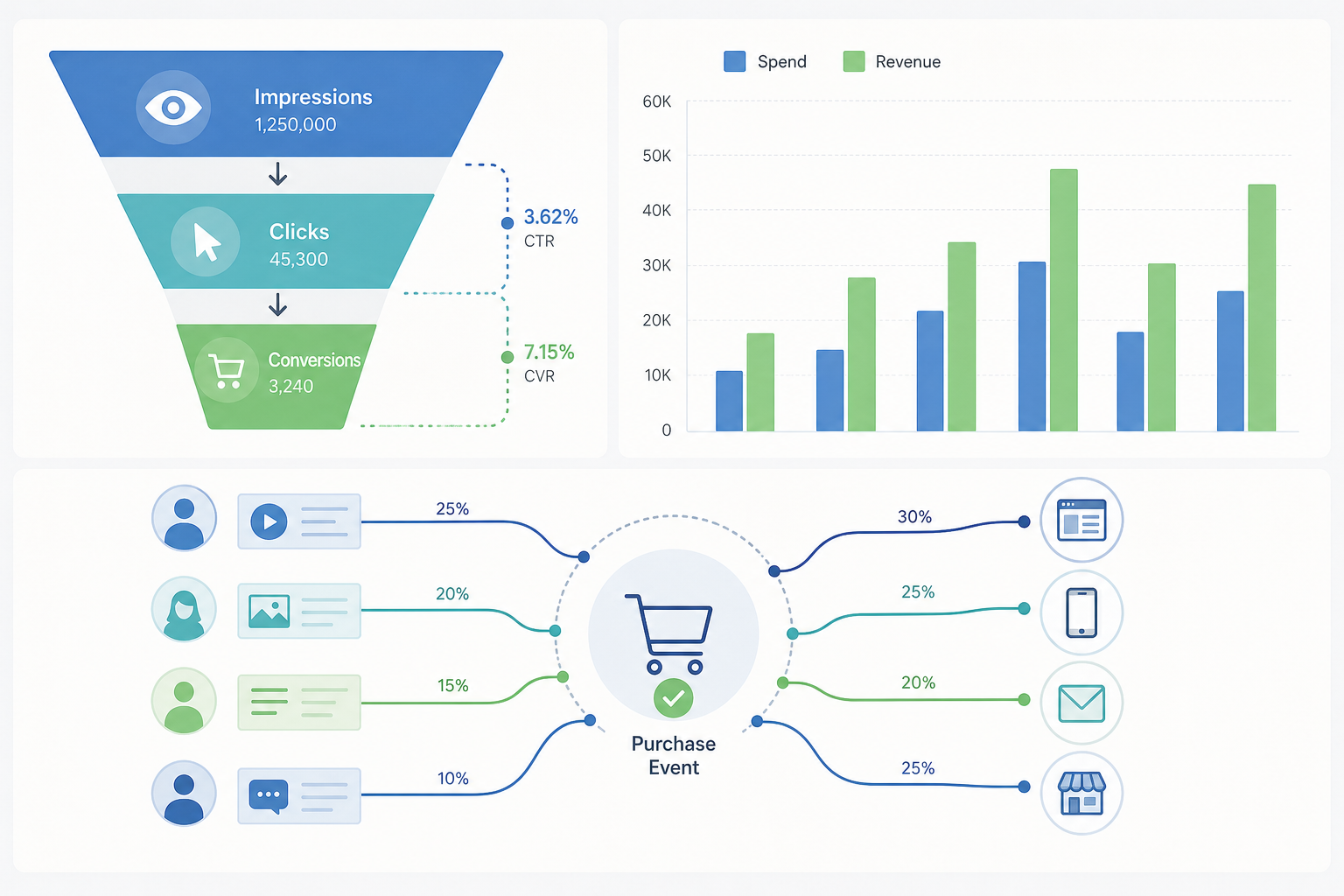
The metrics, methods, and frameworks marketers use to turn campaign data into clear evidence of revenue impact.
Turn campaign data into clear revenue evidence
Track what actually drives revenue by connecting your campaign data to the metrics that matter most.
Why most brands measure the wrong things first
Performance marketing is built on the premise that every dollar spent should be traceable to a result. But in practice, many brands still default to measuring reach, impressions, and follower growth, metrics that describe visibility, not revenue. The core problem is that vanity metrics feel like progress while obscuring whether the campaign actually moved product.
The starting point for any ROI measurement framework is defining what a return means for your specific campaign. For a brand running KOL content on TikTok Shop, a return might be tracked orders attributable to a creator's video. For a Shopee livestream, it might be units sold during the broadcast window. Clarity on the target outcome before launch is what separates measurable campaigns from ones that get rationalised after the fact. If you are still working out how to structure influencer and KOL campaigns before measuring them, that context shapes everything downstream.
The core metrics that connect spend to revenue
Performance marketing ROI is typically expressed as a ratio of revenue generated to campaign spend, but that single number rests on several underlying metrics you need to track simultaneously.
Return on ad spend (ROAS) is the most direct: revenue divided by the total cost of the campaign. Alongside it, cost per acquisition (CPA) tells you what you paid for each converted customer, and conversion rate shows what proportion of people who engaged with content went on to buy. For KOL and creator campaigns specifically, tracking attributed sales per creator is essential, because aggregate ROAS can mask the fact that one creator drove most of the revenue while others contributed little.
Click-through rate (CTR) and engagement rate sit one level up the funnel. They are not ROI metrics on their own, but they are leading indicators: low CTR on a shoppable video suggests the creative is not compelling enough to drive the traffic that would eventually convert. Understanding how UGC content drives trust and purchase intent helps explain why creator-led assets often outperform brand-produced ads on these metrics.
Attribution is the hardest part to get right
Knowing that sales happened during a campaign is not the same as knowing the campaign caused them. Attribution, the process of crediting the right touchpoint for a conversion, is where performance measurement gets genuinely difficult.
For social commerce campaigns on TikTok Shop or Shopee, platform-native attribution tools can link a purchase back to a specific video or livestream session. Unique discount codes and trackable affiliate links assigned to individual creators are among the most reliable low-tech attribution methods available, because they create a direct, auditable link between a creator's content and a completed order. UTM parameters in link-in-bio or product page links serve the same function for traffic that passes through a browser.
Multi-touch attribution becomes relevant when a buyer interacts with several pieces of content before purchasing. In that scenario, giving full credit to the last touchpoint undervalues earlier creators who built awareness and intent. Most brands running influencer marketing campaigns at scale use a blended approach: platform attribution for direct conversions, combined with incremental lift analysis to estimate the broader revenue effect.
Measuring KOL campaigns at three distinct levels
KOL campaigns require measurement at three levels: individual creator performance, content performance, and overall programme performance. Collapsing these into a single number loses the insight that makes future campaigns better.
At the individual creator level, track attributed sales, CPA, and conversion rate per creator. This tells you which creators are genuinely driving purchases versus which are generating engagement that does not convert. At the content level, compare video completion rates, CTR, and saves across different formats and scripts to identify what creative approach resonates. At the programme level, aggregate ROAS, total attributed revenue, and cost per new customer acquired give you the headline figure to report upward.
For brands running ongoing creator programmes rather than one-off campaigns, tracking repeat purchase rate among customers acquired through KOL content adds a lifetime value dimension to the ROI calculation. A creator who drives a high volume of first-time buyers who never return has a lower true ROI than the headline conversion numbers suggest. You can explore the broader KOL vs influencer distinction to understand how creator type affects these outcomes.
Reporting ROI in a way that drives decisions
A measurement framework is only valuable if it produces reports that lead to action. The most useful ROI reports for performance marketing campaigns answer three questions: which channels and creators delivered the best return, what creative variables correlated with higher conversion, and where budget should be reallocated next cycle.
Cadence matters as much as content. Weekly performance snapshots during a live campaign let you cut underperforming creators early and redirect budget. Post-campaign analysis, typically conducted two to four weeks after a campaign closes to allow for delayed conversions, gives the complete picture. Presenting results as cost per acquisition alongside total attributed revenue, rather than just percentage ROI, tends to be more actionable for budget decisions.
For brands expanding into new markets or platforms, baseline ROI data from an initial campaign becomes the benchmark against which subsequent campaigns are measured. Brands entering the Singapore market, for instance, often use their first campaign's CPA as the target to beat in the next cycle. If you are also evaluating influencer marketing ROI specifically, the same measurement logic applies with some platform-specific adjustments.
ROI measurement only becomes useful when you track the full path from content view to completed purchase, not just the reach numbers in between.
How to build a performance marketing ROI measurement framework
-
Define your revenue outcome before launch
Before any campaign goes live, specify exactly what a conversion means: a completed purchase, a sign-up, a first deposit, or a product added to cart. Ambiguous success criteria make post-campaign attribution arguments inevitable. Write the target metric and the measurement method into the campaign brief so every stakeholder agrees upfront.
-
Set up trackable links and creator codes
Assign each creator or channel a unique discount code, affiliate link, or UTM-tagged URL before content goes live. This is the most reliable way to attribute sales to specific creators without relying entirely on platform-reported data. For TikTok Shop and Shopee campaigns, platform-native affiliate tracking is available and should be activated alongside any external tracking you set up.
-
Establish your baseline cost figures
Collect all costs that belong in the denominator of your ROI calculation: creator fees, production costs, platform ad spend, and agency management fees. Leaving out production costs or usage rights fees understates the true spend and inflates your apparent ROAS. Understanding the full cost structure of KOL campaigns ensures your baseline is accurate.
-
Monitor leading indicators during the campaign
Track CTR, video completion rate, and add-to-cart events in real time during the campaign window. These leading indicators signal whether the creative is working before the final conversion data is in. If CTR is low, the hook or thumbnail may need adjusting. If completion rate drops early, the script may be losing viewers before the call to action.
-
Calculate ROAS, CPA, and attributed revenue post-campaign
Once the campaign closes, pull attributed revenue from each tracking source and divide by total spend to get ROAS. Calculate CPA by dividing total spend by the number of new customers acquired. Break these figures down by creator and by content format, not just in aggregate, so you can identify what drove performance and what did not.
-
Document findings and set the next benchmark
Record the campaign's CPA, ROAS, top-performing creators, and best-performing content formats in a structured report. This data becomes the benchmark for your next campaign. Incremental improvement across cycles is what separates brands that build compounding ROI from those that treat each campaign as a standalone experiment.
Benefits
Clarity on which creators convert
Creator-level attribution reveals which KOLs actually drive purchases versus which generate engagement that stops short of a sale. Attributed sales per creator is the metric that makes future budget allocation decisions defensible.
Accurate cost-per-acquisition figures
Including all costs (creator fees, production, ad spend, and management) in your CPA calculation gives you a true picture of what each new customer costs. Understating campaign costs inflates apparent ROAS and leads to poor reinvestment decisions.
A benchmark that improves over time
Each campaign's CPA and ROAS data becomes the benchmark for the next. Compounding improvement across cycles is only possible when measurement is consistent and the findings are documented rather than discarded after each campaign.
Creative direction grounded in data
Tracking content performance metrics (completion rate, CTR, conversion rate by format) reveals which creative approaches drive results. Data-informed creative briefs reduce wasted spend on formats that have already proven not to convert.
Reliable reporting for budget decisions
Presenting ROI as both ROAS and CPA gives budget holders the numbers they need to approve reinvestment. Clear, consistent reporting makes the case for scaling what works and cutting what does not.
ROI measurement in practice: real campaign scenarios
Beauty brand running a multi-creator TikTok Shop campaign
A beauty brand activates ten creators simultaneously for a new skincare launch on TikTok Shop. Each creator receives a unique affiliate link and a personalised discount code. After two weeks, the marketing team pulls attributed sales by creator and finds that two creators account for the majority of converted orders, while several others generated high view counts but negligible purchases. The data informs a reallocation: budget for the next cycle concentrates on the high-converting creators, and the underperformers are replaced. The CPA from cycle one becomes the target to beat in cycle two. For brands considering how TikTok live streamers fit into this mix, livestream attribution follows the same creator-level logic.
Health supplement brand entering the Singapore market via Shopee
An overseas health supplement brand launches on Shopee in Singapore and runs its first KOL campaign with a small cohort of local creators. Because it has no prior Singapore data, the first campaign's CPA serves as the baseline. The team tracks platform-native Shopee affiliate data alongside UTM-tagged traffic to the product listing. Post-campaign analysis reveals that video content outperforms static posts on conversion rate, and that a mid-tier creator with a highly engaged audience in the wellness niche delivered the lowest CPA. The brand uses these findings to brief its second campaign with a clear creative direction and a target CPA to improve on.
Lifestyle brand measuring UGC content performance over time
A lifestyle brand commissions a batch of UGC videos for use as paid social ads. Rather than measuring each video in isolation, the marketing team tracks content performance over a rolling 90-day window, comparing CTR, conversion rate, and cost per purchase across formats. Videos featuring unboxing and in-use demonstrations consistently outperform talking-head testimonials on conversion rate. This finding shapes the next UGC brief, shifting the mix toward demonstration-led formats. UGC content strategy and performance measurement are most effective when treated as a continuous feedback loop rather than a one-time exercise.
Financial services brand tracking leads from a KOL programme
A financial services brand runs a KOL programme where conversion is defined as a completed account sign-up rather than a product purchase. Each creator's content includes a unique referral link that passes a creator ID through to the sign-up form. The team tracks sign-ups, cost per sign-up, and the downstream activation rate of referred accounts (whether sign-ups go on to make a first transaction). This two-stage measurement approach gives a more accurate picture of true ROI than sign-up volume alone, because it accounts for the quality of the leads each creator generates, not just the quantity.
How to measure ROI from performance marketing campaigns: common questions
What is the difference between ROAS and ROI in performance marketing?
ROAS (return on ad spend) measures revenue generated relative to the direct cost of running the campaign, typically ad spend and creator fees. ROI is broader: it factors in all costs, including production, agency fees, and overheads, and is usually expressed as a net profit figure relative to total investment. Both are useful, but ROAS is faster to calculate and more commonly used for campaign-level decisions, while ROI gives the fuller business picture.
How do you attribute sales to a specific KOL or creator?
The most reliable methods are unique discount codes, trackable affiliate links, and UTM parameters assigned to each creator before content goes live. On platforms like TikTok Shop and Shopee, native affiliate tracking can link a completed purchase directly to the creator's video or livestream. For campaigns where buyers interact with multiple creators before purchasing, a blended attribution model that credits multiple touchpoints gives a more accurate picture than last-click attribution alone.
How do you measure ROI from performance marketing campaigns that run across multiple platforms?
Cross-platform measurement requires a consistent attribution methodology applied to each channel separately, then aggregated. Assign platform-specific tracking links and creator codes on each platform, pull attributed revenue by platform after the campaign, and calculate CPA and ROAS per channel. This lets you compare platform efficiency directly rather than blending figures that may reflect very different audience behaviours and conversion paths. You can read more about measuring influencer marketing ROI for a deeper look at the methodology.
Which metrics should a brand report to senior stakeholders after a KOL campaign?
The most decision-relevant metrics for senior stakeholders are total attributed revenue, ROAS, and cost per acquisition, presented alongside total campaign spend. Engagement metrics (views, likes, shares) can provide context but should not be the headline figures. Where possible, include a comparison to the previous campaign's CPA to show directional improvement, and flag the top-performing creators and content formats so the findings translate directly into the next campaign brief.
Build campaigns where ROI is measurable from day one
If you are running KOL, livestream, or UGC campaigns and want a clearer picture of what is actually driving revenue, the measurement framework starts with how the campaign is structured. Reach out to discuss how Confetti builds attribution into performance campaigns from the brief stage, so the data you collect is actionable from day one.