A practical guide to identifying inflated metrics, poor measurement, and creator-brand misalignment before you sign.
Evaluate influencer agencies with confidence
Audit your next agency shortlist with this checklist of concrete warning signs that separate credible partners from budget-burning ones.
Fake followers are more common than most agencies admit
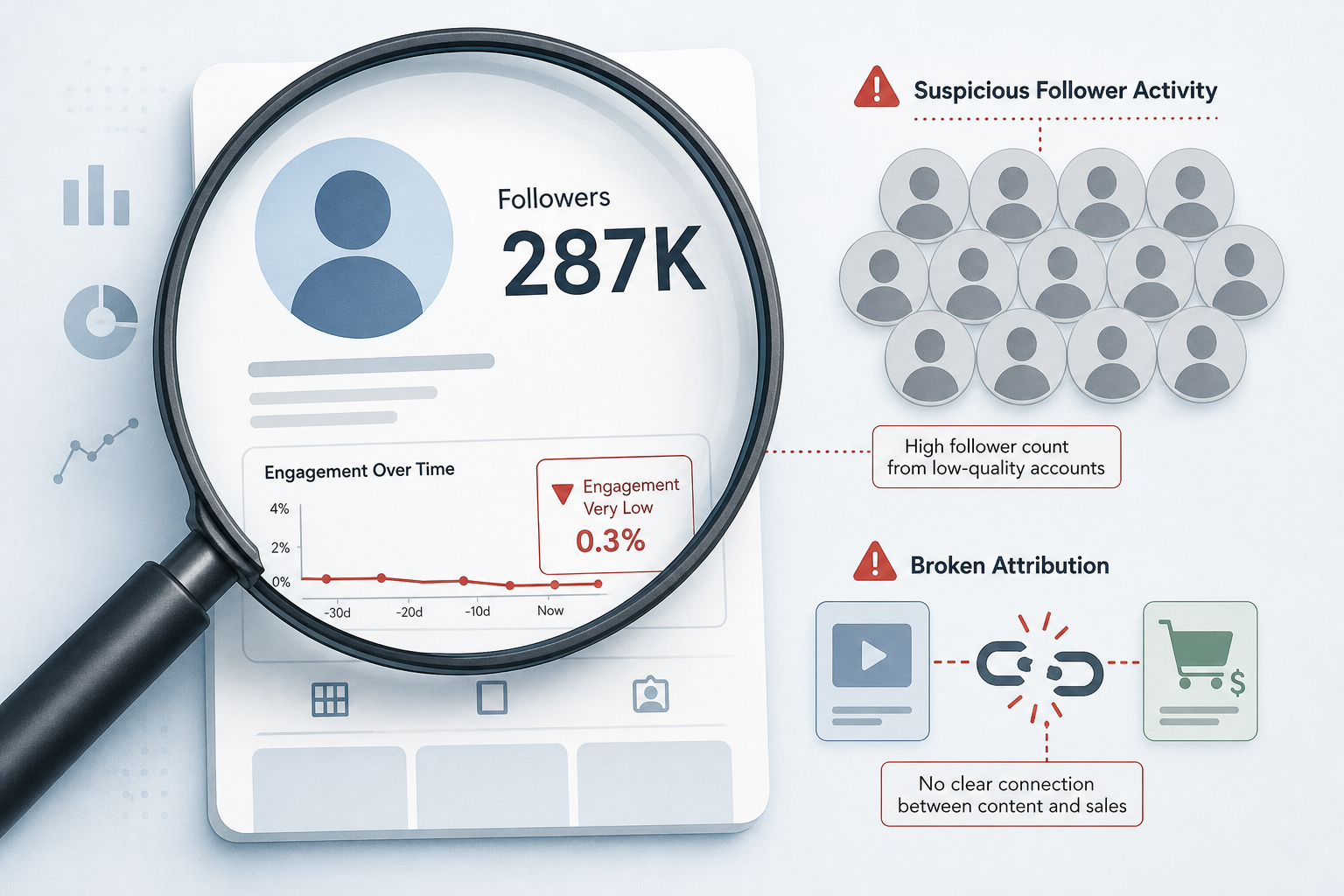
Approximately 15 to 20% of accounts on major social platforms contain some level of inauthentic engagement, and only about one in ten marketers reported no fraud or audience-quality issues at all. That means the odds are high that at least one creator in any shortlist has inflated numbers. The clearest manual signal is a follower-to-engagement mismatch. A creator with 200,000 followers receiving only 200 to 400 likes per post is operating at a 0.1 to 0.2% engagement rate, well below the 1 to 3% range typical of genuine accounts. Look also at comment quality: generic responses like "Nice!" or emoji-only replies from accounts with no profile photos are a reliable indicator of purchased engagement. Fake follower accounts tend to share a recognisable profile: no photo, no posts, a computer-generated username, and a following-to-follower ratio of 1,000 to 5 or worse. Follower growth history is equally telling. A sharp spike followed by a flat or declining line, with no sustained organic activity, points to a bulk purchase rather than earned audience growth. When evaluating an agency, ask whether they run systematic checks on every creator they recommend, not just the ones you flag yourself.
Vanity metrics are not a campaign report
An agency that hands you a screenshot of likes and views at the end of a campaign has not measured anything useful. A good report does not stop at likes, views, or a screenshot from Instagram Insights. Influencer marketing ROI requires tracking metrics across three stages: awareness (reach and impressions), engagement (clicks, saves, and shares), and conversion (sales, signups, and revenue). Most agencies that rely on vanity metrics do so because they have not built the attribution infrastructure to go further. Conversion tracking requires UTM parameters on every link, influencer-specific landing pages or promo codes, and post-purchase surveys to connect sessions back to individual creators. Conversion metrics typically peak three to seven days after a post goes live, then taper off over two to four weeks, so a report pulled the day after posting will always look weaker than the full picture. Demand a reporting framework upfront, before the campaign launches, so there is no ambiguity about what success looks like. If an agency cannot tell you which creator drove which sale, they cannot help you optimise the next campaign. For a deeper look at what proper influencer marketing ROI measurement involves, the methodology matters as much as the tools.
Creator-brand fit failures are the quietest budget drain
An influencer can have a genuine, engaged audience and still be the wrong choice for your brand. If their following is far removed from your target demographic, the reach is real but the relevance is not. This is one of the most common and least-discussed red flags: an agency that optimises for follower count or engagement rate without verifying audience demographics against your actual customer profile. The most reliable check is asking for analytics screenshots showing audience location, the metric hardest to fake convincingly. A beauty brand targeting Singapore women aged 25 to 35 needs to see that the creator's audience actually reflects that segment, not just that the creator posts beauty content. Agencies that skip this step often do so because their creator roster is built for scale, not fit. The result is campaigns that generate impressions among audiences who will never buy. Understanding the difference between a KOL and a general influencer matters here: domain credibility shapes whether an audience trusts a recommendation enough to act on it.
Conversion tracking gaps leave you flying blind
With 32% of consumers reporting a purchase through an influencer's sponsored post in the past 12 months, the commercial case for influencer marketing is clear. What is less clear, in many campaigns, is which specific creator or piece of content drove that purchase. Agencies that cannot answer that question are not running performance marketing; they are running awareness campaigns and calling them performance. The minimum viable attribution stack includes UTM-tagged links for every creator, unique promo codes tied to individual posts, and a post-campaign survey asking buyers how they discovered the product. On platforms like TikTok Shop and Shopee, native analytics add another layer: you can track which creator's livestream or short video directly generated a cart add or completed order. An agency operating on these platforms without using that native data is leaving the most reliable signal unused. If an agency's proposal does not mention attribution methodology, that absence is itself a red flag. Ask specifically: how will we know which creator drove which conversion? The answer will tell you more about the agency's capabilities than any case study deck. For brands exploring social commerce creator marketing, conversion attribution is the foundation, not an optional add-on.
Reach without relevance is just noise, and an agency that cannot prove otherwise is spending your budget on impressions that will never convert.
Benefits
Verified creator audience quality
A credible agency runs systematic audience audits on every creator they recommend, checking for fake follower percentages above 25%, engagement rate anomalies, and suspicious comment patterns before a brief is even written.
Transparent, conversion-linked reporting
Strong agencies report across all three measurement tiers: awareness, engagement, and conversion. UTM parameters, unique promo codes, and post-purchase surveys connect individual creators to actual sales, not just impressions.
Audience-fit matching before creator selection
The right agency validates that a creator's audience demographics, particularly location, age, and gender, match your target customer profile before recommending them, not after the campaign has run.
End-to-end conversion attribution
On platforms like TikTok Shop and Shopee, native analytics allow agencies to trace a completed order back to the specific creator, video, or livestream that generated it, making campaign optimisation data-driven rather than intuitive.
Common questions about influencer marketing agency red flags
How can I audit a creator's follower quality myself before briefing an agency?
Start with the engagement rate: divide total likes and comments by follower count and compare against the 1 to 3% benchmark typical for genuine accounts. Then review the follower list manually for accounts with no profile photo, no posts, and computer-generated usernames. Tools like Modash or HypeAuditor can automate this and flag profiles where more than 25% of followers appear suspicious. Finally, ask the creator or agency for an analytics screenshot showing audience location, which is the hardest metric to convincingly fake.
What metrics should I demand in an influencer campaign report?
A complete report covers all three measurement tiers: awareness (reach and impressions), engagement (clicks, saves, shares, and comment sentiment), and conversion (sales, signups, and revenue attributed to each creator). Vanity metrics alone, such as likes or follower counts, are not a campaign report. Ask for UTM-level traffic data, promo code redemption rates, and, on TikTok Shop or Shopee, native platform conversion data tied to individual creator content.
Do micro-influencers carry lower fraud risk than larger accounts?
Generally, yes. Smaller creators tend to have more organic, community-driven audiences, and the economics of buying followers are less attractive at lower follower counts. However, fake engagement is not exclusive to large accounts, and micro-influencers can still have inflated numbers. The same audit process applies: check engagement rate, comment quality, follower profile completeness, and audience location regardless of creator tier.
What should I do if an agency resists sharing creator analytics?
Resistance to sharing audience analytics is itself a significant red flag. A credible agency has nothing to hide and should be able to provide audience location breakdowns, engagement rate history, and follower growth charts for every creator they recommend. If an agency cites creator privacy as a reason, note that platform analytics screenshots can be shared without exposing personal data. Persistent refusal suggests the numbers will not hold up to scrutiny.
How does creator-brand fit differ from niche relevance?
Niche relevance means the creator posts content related to your product category. Creator-brand fit goes further: it means the creator's actual audience demographics, values, and purchase behaviour align with your target customer. A fitness influencer posting about supplements is niche-relevant, but if their audience skews toward a demographic that does not match your buyer profile, the campaign will underperform regardless of engagement rate. Always validate fit at the audience level, not just the content level. Understanding what makes a KOL effective can help clarify this distinction.
When red flags become real losses
Beauty brand burned by inflated engagement
A beauty brand briefed an agency on a product launch campaign targeting Singapore women. The agency presented a creator with strong follower numbers and a visually polished feed. No audience audit was conducted. Post-campaign, the brand noticed that engagement had come almost entirely from accounts with no profile photos and generic comments, and that the creator's audience was concentrated in a geography far outside Singapore. The campaign generated impressions but no measurable lift in sales or site traffic. The red flag was visible before the brief was signed: the engagement rate was well below the 1 to 3% benchmark for genuine accounts, and no analytics screenshot had been requested.
Health supplement campaign with the wrong audience
A health supplement brand selected a creator based on niche relevance: the creator posted regularly about fitness and wellness. The agency did not validate audience demographics before recommending them. When the campaign ran, the brand's post-purchase survey revealed that almost none of the new buyers had come from the influencer's content. A review of the creator's analytics, requested after the fact, showed that the audience skewed heavily toward a demographic outside the brand's target age and income range. Audience-fit matching at the selection stage, not after the campaign, would have caught this before budget was committed. For brands working with KOL campaigns, demographic validation is a non-negotiable first step.
E-commerce brand with no conversion attribution
An e-commerce brand ran a multi-creator campaign across TikTok and Instagram. The agency delivered a report showing strong reach and engagement figures. When the brand's marketing manager asked which creator had driven the most sales, the agency could not answer: no UTM parameters had been set up, no unique promo codes had been issued, and no post-purchase survey had been deployed. The brand had no way to identify which content had performed commercially or how to allocate budget for the next campaign. This is a structural failure, not a reporting oversight. Brands running campaigns on TikTok Shop or Shopee have access to native conversion data that makes this attribution straightforward, but only if the agency is set up to use it from the start.
Work with an agency that measures what actually matters
If you are evaluating influencer agencies in Singapore and want a partner that audits creator audiences, builds attribution into every campaign, and reports on conversion rather than just reach, Confetti's approach is built around exactly those standards. Reach out to discuss how we vet creators and structure campaigns for measurable outcomes.