A practical guide to tracking, measuring and optimising influencer marketing performance so every campaign drives real results.
Turn your influencer data into smarter campaign decisions
Connect with Confetti to build influencer campaigns where every metric ties back to measurable revenue growth.
Why vanity metrics alone will mislead you
Follower counts and raw impression numbers are the most visible outputs of any influencer campaign, but they are also the least reliable indicators of business impact. A creator with a large following can generate hundreds of thousands of views on a post and produce zero sales if the audience is mismatched, the content lacks a clear call to action, or the product has no natural fit with that creator's niche. Reach and impressions tell you who saw the content; conversion metrics tell you whether any of them acted on it. The distinction matters because brands that optimise for reach alone tend to overspend on top-tier creators and underinvest in the micro and mid-tier creators who often drive higher engagement rates and more targeted purchase intent. Before setting up any tracking framework, it helps to understand the difference between KOLs and influencers and what each tier is realistically expected to deliver.
The three levels of influencer marketing measurement
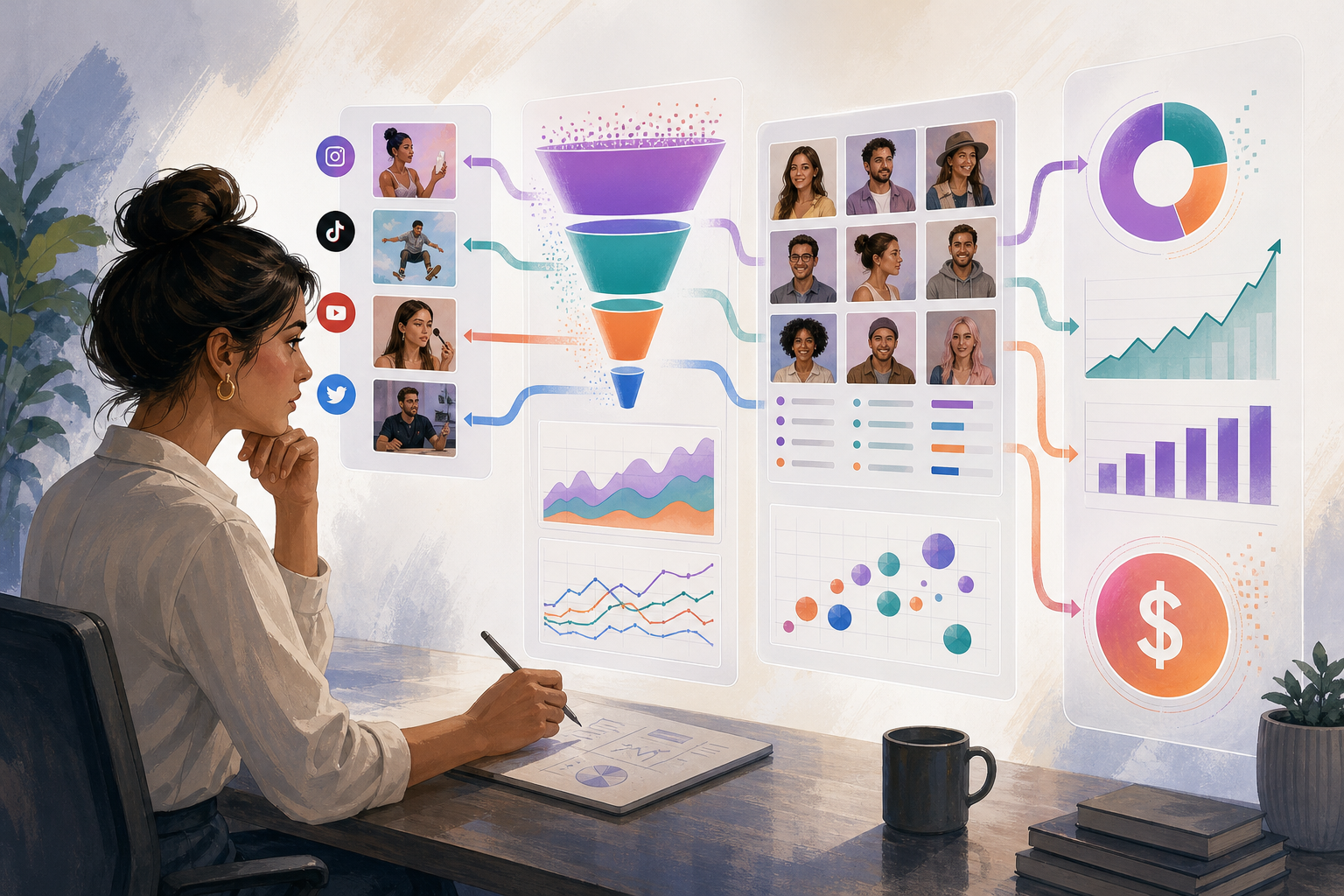
Measure performance at three levels: individual creator performance, content performance, and overall programme performance. At the creator level, you are assessing whether a specific KOL drove the engagement, clicks, or conversions you expected given their audience size and niche. At the content level, you are comparing which formats (short video, livestream, static post, UGC) performed best for a given objective. At the programme level, you are evaluating whether the campaign as a whole moved business metrics: revenue, new customer acquisition, or category share. Most brands track only the first level and miss the strategic insight that comes from the second and third. For a deeper look at how these levels connect to return on investment, see the full guide on how to measure ROI from influencer marketing.
Attribution methods that connect content to sales
Attribution is the practical challenge at the heart of influencer measurement. The cleanest methods are those that create a direct, trackable path from content to purchase. Unique discount codes assigned per creator let you tie every redemption back to a specific post or livestream. UTM-tagged links in bios, link-in-bio tools, or swipe-up stories give you click-level data in your analytics platform. On platforms like TikTok Shop and Shopee, native checkout data provides an even more direct signal because the purchase happens inside the same platform where the content lives. This is one reason why shoppable livestream campaigns on Shopee and TikTok Shop have become a preferred format for performance-focused brands: the conversion event is captured natively, removing much of the attribution guesswork. For content that runs off-platform, post-campaign surveys asking customers how they heard about the brand can supplement the quantitative data.
Brand lift and longer-term signals
Not every campaign outcome is immediate or transactional. Brand lift measurement captures the less tangible but real effects of influencer activity: increases in branded search volume, improvements in brand recall or sentiment, and growth in organic social following. Branded search volume is one of the most accessible proxies for brand lift because it is trackable through standard search tools and tends to spike during and after well-executed influencer campaigns. Sentiment analysis on comments and mentions gives a qualitative read on whether the content is building positive associations. These signals matter most for brands in early market entry phases or categories where the purchase cycle is long, such as health supplements, financial services, or travel. Brands entering a new market, for example through a local market expansion strategy, should weight brand lift metrics more heavily than immediate conversion data in the first campaign cycle.
Optimising campaigns based on what the data shows
Measurement without action is just reporting. The optimisation loop starts with identifying which creators, formats, and messages are outperforming, then reallocating budget and effort toward those. If short video content from mid-tier creators is generating a lower cost-per-click than a single top-tier post, that is a signal to shift the content mix. If a particular product angle (ingredient story, before-and-after, tutorial) is driving more saves and shares than a straightforward product showcase, that insight should feed back into the creative brief for the next campaign. Always-on influencer programmes make this loop more efficient because they accumulate data across multiple cycles, allowing you to spot patterns that a one-off campaign cannot reveal. UGC content produced through influencer campaigns can also be repurposed as paid social creative, extending the value of every piece of content beyond its original organic reach.
Reach and impressions tell you who saw the content; conversion metrics tell you whether any of them acted on it.
How to build your influencer measurement framework
-
Define objectives before selecting metrics
Start by articulating what the campaign is actually trying to achieve: awareness, consideration, conversion, or retention. Each objective maps to a different primary metric: awareness campaigns prioritise reach and video view rate; conversion campaigns prioritise click-through rate, add-to-cart rate, and orders. Selecting metrics before setting objectives leads to misaligned reporting where a campaign looks successful on paper but fails to move the business goal. Document the objective and its corresponding KPIs in the campaign brief so every stakeholder is aligned from the start.
-
Set up tracking infrastructure before launch
Issue unique discount codes or affiliate links to each creator before the campaign goes live. Configure UTM parameters for any off-platform links so traffic sources are identifiable in your analytics tool. If you are running campaigns on TikTok Shop or Shopee, ensure your product listings are correctly set up to capture native platform data. Setting up tracking after a campaign has launched means losing data that cannot be recovered retroactively. For brands working with a KOL marketing agency, confirm that tracking setup is part of the pre-launch checklist.
-
Collect data at the creator and content level
During the campaign, gather performance data for each creator and each piece of content separately. Key data points include: views, engagement rate (likes, comments, shares, saves), click-through rate, conversion rate, and revenue attributed. Engagement rate is more meaningful when calculated against views rather than followers, because follower counts include inactive accounts. On livestream formats, also track average watch time, peak concurrent viewers, and the conversion rate from viewers to purchasers, as these reveal how well the host and content held the audience's attention. See how TikTok live streamers drive these metrics in a commerce context.
-
Analyse performance across the three levels
Once data is collected, analyse it at the creator level, content level, and programme level in sequence. At the creator level, rank creators by cost-per-result for the primary objective. At the content level, identify which formats and messages generated the strongest signals. At the programme level, calculate the total return against the total investment, including production costs, creator fees, and platform spend. A creator who appears expensive at the individual level may still be the best performer at the programme level if their content generated significant organic reach beyond the initial post.
-
Feed insights back into the next campaign brief
The final step is translating data into decisions. Document which creator profiles, content formats, and product angles outperformed, and use that to sharpen the brief for the next campaign cycle. If budget allows, retain the top-performing creators for an always-on arrangement rather than a one-off post. Repeated collaboration with proven creators reduces the cost of testing and builds more authentic, consistent brand presence over time. Consider how UGC creation from high-performing influencer content can be repurposed for paid social to extend the campaign's commercial life.
Benefits
Clearer picture of what drives sales
A structured measurement framework separates the creators and content formats that genuinely drive purchases from those that generate surface-level engagement without commercial impact, so budget goes to what works.
Smarter creator selection over time
Tracking performance at the creator level across multiple campaigns builds a data-driven shortlist of proven partners, reducing the cost and risk of testing new creators with every brief.
Attribution that holds up internally
Unique discount codes, UTM links, and native platform data create auditable, stakeholder-ready attribution that makes it easier to justify influencer spend to finance and leadership teams.
Content insights that improve creative briefs
Analysing which messages, formats, and product angles outperform gives creative teams specific direction rather than vague feedback, shortening the iteration cycle on future campaigns.
Longer-term brand signals alongside short-term sales
Measuring brand lift indicators such as branded search volume and sentiment alongside conversion data gives a complete view of campaign value, especially for brands in awareness or market entry phases.
Measurement in practice: real campaign scenarios
Beauty brand tracking creator-level conversion on TikTok Shop
A beauty brand running a multi-creator TikTok Shop campaign assigns a unique affiliate link to each creator and tracks orders attributed to each link over a two-week window. After the campaign, the data shows that two mid-tier creators with engaged niche audiences generated a significantly higher conversion rate than a single top-tier creator with broader reach. The cost-per-order from the mid-tier creators is substantially lower, prompting the brand to shift its next campaign budget toward a larger pool of niche creators rather than a single high-follower account. This kind of creator-level attribution is only possible when tracking infrastructure is set up before launch.
Health supplement brand measuring brand lift during market entry
An overseas health supplement brand entering the Singapore market through a local expansion strategy runs an initial influencer seeding campaign with no direct purchase mechanic. Instead of tracking sales, the team monitors branded search volume and social sentiment over the six weeks following the campaign. A measurable uplift in branded searches and a net positive shift in comment sentiment signals that the campaign is building awareness and positive associations. This data justifies a second campaign phase with a direct-to-purchase mechanic, informed by the audience insights gathered in the first phase. For brands in this position, understanding the cost structure of KOL campaigns helps set realistic expectations for each phase.
Lifestyle brand optimising a Shopee livestream series
A lifestyle brand runs a monthly Shopee livestream series and tracks peak concurrent viewers, average watch time, and the ratio of viewers who add to cart during each session. After three sessions, the data shows that sessions hosted by a specific creator with a conversational, tutorial-style format consistently outperform sessions with a more promotional tone. Average watch time is nearly double and the add-to-cart rate is significantly higher in the tutorial-format sessions. The brand shifts all remaining sessions to the tutorial format and retains that creator for the remainder of the quarter, resulting in a measurable improvement in revenue per session. Learn more about Shopee livestream campaigns and how session format affects conversion.
Edtech brand using UGC performance data to inform paid social
An edtech brand commissions UGC-style short videos from a group of creators and runs them as organic posts before repurposing the top performers as paid social ads. The organic performance data (view rate, share rate, comment sentiment) acts as a pre-screening filter, ensuring only proven creative is put behind paid budget. This approach reduces creative testing costs in paid social and produces ads that feel authentic because they were made by real creators rather than a production studio. The brand tracks cost-per-lead separately for influencer-organic, influencer-repurposed-paid, and studio-produced creative to build a clear picture of which source delivers the best return. See how UGC marketing supports this kind of integrated measurement approach.
Influencer marketing performance: common questions answered
What are the most important metrics for influencer marketing campaigns?
The most important metrics depend on the campaign objective. For conversion-focused campaigns, cost-per-order, click-through rate, and attributed revenue are the primary indicators. For awareness campaigns, video view rate, reach, and branded search uplift matter more. Engagement rate (calculated against views, not followers) is a reliable mid-funnel signal across most campaign types.
How do you attribute sales to a specific influencer or post?
The most reliable methods are unique discount codes or affiliate links assigned per creator, which tie every redemption or click directly to a specific piece of content. On platforms like TikTok Shop and Shopee, native checkout data provides direct attribution because the purchase happens inside the platform. UTM-tagged links supplement this for off-platform traffic.
What is brand lift and how do you measure it?
Brand lift refers to the improvement in brand awareness, recall, or sentiment that results from a campaign, beyond direct sales. Branded search volume is one of the most accessible proxies: a spike in searches for your brand name during or after a campaign indicates the content is building awareness. Comment sentiment analysis and social following growth are complementary qualitative signals.
How often should you review influencer campaign performance?
For active campaigns, a mid-campaign review at roughly the halfway point allows you to reallocate budget toward top-performing creators before the campaign ends. For programme-level analysis, a quarterly review cycle gives enough data to identify patterns across creator types, content formats, and audience segments that a single campaign cannot reveal.
Can influencer content be reused to improve paid social performance?
Yes. Organic influencer and UGC content that performs well in terms of view rate, share rate, and comment sentiment can be repurposed as paid social creative. Using organic performance as a pre-screening filter means only proven content goes behind paid budget, reducing creative testing costs and producing ads that feel more authentic to the audience.
Build influencer campaigns with measurement at their core
If you are running influencer or KOL campaigns in Singapore and want a clearer picture of what is actually driving results, Confetti builds and manages performance-driven creator programmes with measurement built in from the start. Reach out to discuss how a structured tracking approach can improve the return on your next campaign.