Concrete strategy examples across awareness, conversion, and market entry, with the measurable outcomes that matter.
Bring your campaign brief to a team that has run these strategies
Talk through your campaign structure with Confetti's strategy team and get a clearer picture of what will actually move the needle for your brand.
Strategy type shapes outcomes more than follower count
The most common mistake brands make when planning an influencer campaign is leading with reach. Follower count is visible and easy to compare, but it tells you almost nothing about whether a creator's audience will buy your product. Audience-to-brand fit is the variable that separates campaigns that convert from those that merely impress on paper.
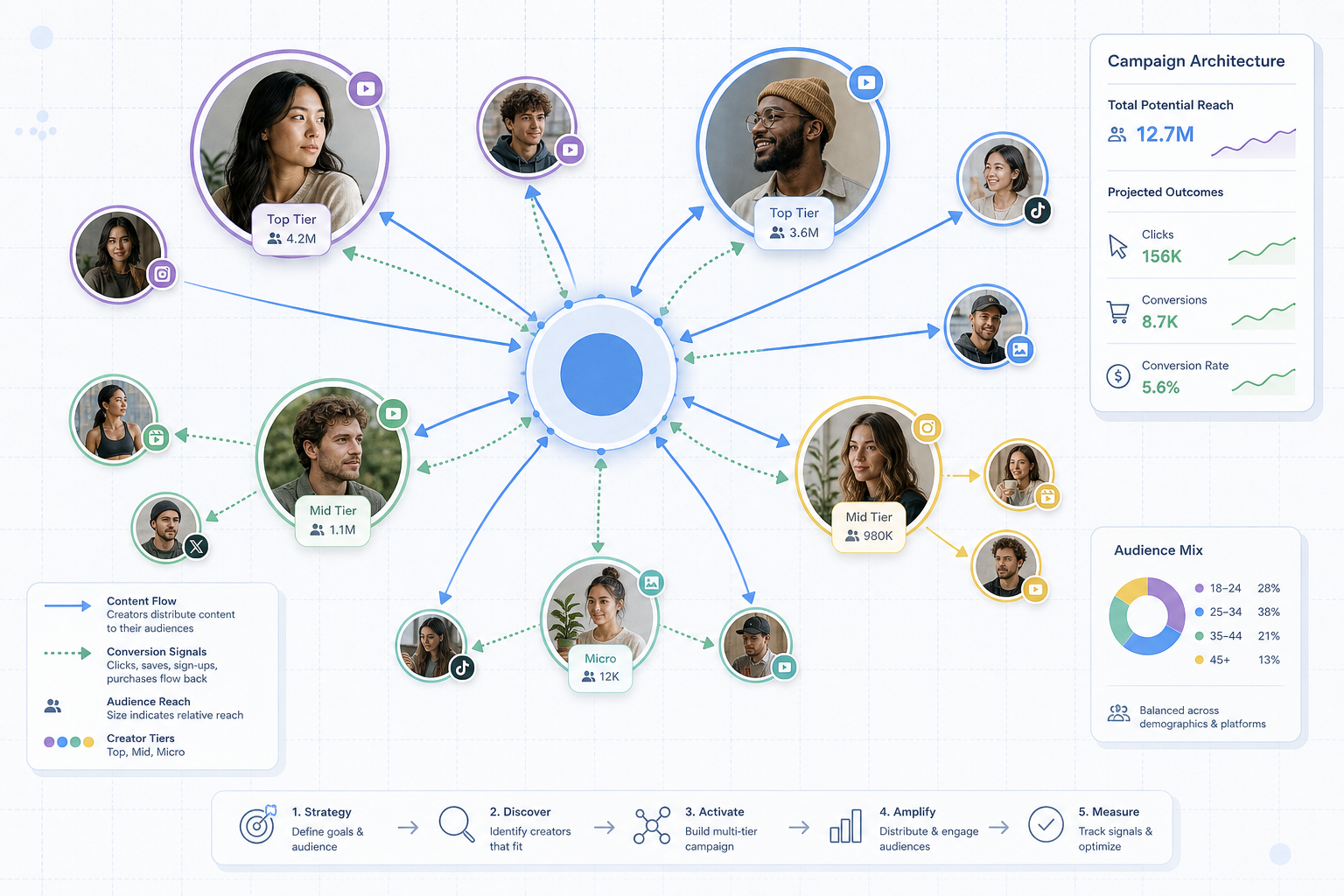
Strategy type, meaning the structural choices you make about creator tier, content format, campaign duration, and success metric, determines what a campaign can realistically deliver. A brand launching into a new market needs a different structure than one trying to defend shelf space in a category it already owns. Before selecting a single creator, the most effective campaigns define the objective first, then work backwards to the strategy that serves it. Understanding how different structures perform in practice is the fastest way to sharpen that thinking. For a broader view of how KOL campaigns are planned and managed, the strategic logic is the same regardless of platform.
Macro versus micro influencers produce different measurable results
Macro influencers (creators with large, broad audiences) are well suited to campaigns where the primary goal is awareness at scale. A single macro post can generate significant reach quickly, and the production quality of established creators often lends credibility to a brand's positioning. The trade-off is that broad audiences tend to produce lower engagement rates and weaker purchase intent signals, because the creator's followers span many demographics and interest clusters.
Micro influencers, by contrast, typically maintain tighter audience relationships and higher engagement rates within a specific niche. A skincare brand partnering with a micro creator who focuses exclusively on sensitive-skin routines will reach a smaller but far more qualified audience. In performance-driven campaigns where the goal is conversion rather than awareness, micro influencer programmes consistently outperform macro approaches on a per-engagement basis. The practical implication: brands with clearly defined target demographics and a conversion objective should weight their creator mix toward micro rather than defaulting to whoever has the largest following. See how KPI selection changes depending on creator tier for a more detailed breakdown.
Long-term ambassadors versus one-off posts serve different goals
A one-off sponsored post is the simplest influencer activation: a brand pays a creator to produce a single piece of content, the post goes live, and the engagement is measured. It works well for product launches, seasonal promotions, or testing whether a creator's audience responds to a brand's category. The limitation is that a single touchpoint rarely builds the trust required to drive purchase decisions, particularly for higher-consideration products.
Long-term ambassador relationships change the dynamic entirely. When a creator works with a brand across multiple months, their audience sees repeated, contextual endorsements rather than an isolated sponsored moment. The creator also develops a deeper understanding of the product, which produces more authentic and specific content over time. For brands in beauty, health, or lifestyle categories where trust is a purchase driver, ambassador structures tend to generate stronger earned media value and more durable brand association. The contractual and creative choices involved in structuring these relationships, including usage rights, exclusivity, and content approval, are worth understanding before committing to either model. Reviewing influencer marketing budgeting considerations alongside this decision helps set realistic expectations.
Product seeding and affiliate structures produce different content types
Product seeding, sending product to creators without a guaranteed post obligation, is a strategy designed to generate authentic, unprompted content. Because the creator has no contractual requirement to post, any content they produce carries a higher credibility signal to their audience. The approach works best when the product has a strong sensory or visual quality that creators will naturally want to share, and when the brand is comfortable with variable output volume.
Affiliate and performance-based structures operate on a different logic. Creators are given a trackable link or discount code, and their compensation is tied directly to the sales they generate. This model aligns creator incentives with brand revenue goals and makes ROI measurement straightforward: you know exactly which creator drove which sale. The trade-off is that creators with highly engaged audiences may prefer flat-fee arrangements, so performance structures tend to work best as part of a mixed model rather than a standalone approach. User-generated content programmes often combine elements of both seeding and affiliate logic, using organic creator content as the raw material for paid amplification.
Four campaign strategy examples across different objectives
Awareness campaign using macro KOLs at launch
A consumer health supplement brand entering the Singapore market needed rapid category awareness before its e-commerce listings went live. The strategic choice was to activate a small group of macro lifestyle and wellness creators for a coordinated launch week, with content formats focused on short-form video and Instagram Stories. Success was measured by reach, video views, and share of voice in the wellness category during the launch window, not by immediate sales. The key creative decision was giving creators significant latitude to frame the product in their own language, which produced more authentic content than a tightly scripted brief would have. For brands considering a similar entry approach, local market entry strategy is worth reviewing alongside creator selection.
Conversion campaign using micro influencers with affiliate codes
A beauty brand with an established TikTok Shop presence wanted to drive direct product sales rather than awareness. The strategy was to recruit a larger pool of micro influencers in the skincare niche, each given a unique affiliate code tied to their audience. Content format was short-form tutorial video, showing the product in use within a routine rather than as a standalone review. Performance was tracked at the creator level: conversion rate per code, average order value from each creator's audience, and total revenue attributed. Creators who outperformed in the first month were offered extended partnerships, turning the campaign into a rolling performance programme. How TikTok Shop commerce campaigns work provides useful context on the platform mechanics behind this model.
Community growth through a long-term ambassador programme
A footwear brand wanted to build a sustained community of engaged followers rather than spike traffic around a single campaign. The approach was to identify creators whose audiences overlapped with the brand's target demographic and sign them to rolling ambassador agreements covering multiple content cycles across several months. Rather than scripting individual posts, the brand provided product access and campaign themes, allowing creators to integrate the brand naturally into their content. Engagement rate and follower growth on the brand's own channels were the primary KPIs, alongside earned media value from creator posts. The long-term structure meant audiences saw consistent brand presence rather than a single sponsored moment, which produced stronger brand recall scores in post-campaign surveys.
Market entry using localised creator content for an overseas brand
An overseas brand preparing to enter the Singapore market faced the challenge of building local credibility quickly without the brand recognition it held in its home market. The strategic choice was to lead with localised creator content rather than adapted home-market assets, partnering with Singapore-based lifestyle creators who could contextualise the product for a local audience. Content formats included unboxing videos, lifestyle integration posts, and short-form reviews in local vernacular. Success metrics included local follower acquisition, engagement from Singapore-based accounts, and traffic to the Singapore-specific product listing. This approach is particularly relevant for brands using a local market entry service as part of a broader regional expansion.
The campaign structure you choose before briefing a single creator will determine more of your result than any individual piece of content ever will.
Benefits
Sharper creator selection criteria
Understanding how different strategy types perform in practice means you evaluate creators on audience fit and content format suitability rather than follower count alone, which is the variable most strongly correlated with campaign performance.
Clearer KPI setting before launch
Each campaign structure, awareness, conversion, community, or market entry, has a distinct set of meaningful metrics. Knowing which structure you are running means you set the right success measures from the start rather than retrofitting metrics after the fact.
Improved content-to-conversion ratio
Matching content format to campaign objective, tutorials for conversion, lifestyle integration for community, coordinated launches for awareness, produces content that is structurally more likely to drive the intended action rather than generating engagement without downstream effect.
Smarter budget allocation across creator tiers
Knowing that micro influencers tend to outperform on conversion while macro creators deliver reach means you can allocate spend across tiers deliberately rather than defaulting to the highest-profile creator your budget will reach.
Platform-specific strategy alignment
TikTok Shop and Shopee each have distinct content mechanics, creator ecosystems, and purchase-flow structures. Campaigns built around platform-native formats (short-form video on TikTok, livestream on Shopee) consistently outperform those that treat the platform as a distribution channel for generic content.
Influencer marketing strategy examples: questions from brand managers
How do I measure ROI on an influencer marketing campaign?
ROI measurement depends on what objective the campaign was built to serve. For conversion-focused campaigns, trackable affiliate codes and platform attribution give you direct revenue data per creator. For awareness campaigns, reach, video views, and earned media value are the relevant measures. The most useful approach is to define your success metric before the campaign launches, then measure at three levels: individual creator performance, content performance, and overall programme performance. A detailed breakdown of influencer KPIs covers each metric and how to calculate it.
Should I work with micro or macro influencers for a product launch?
The answer depends on whether your primary goal is reach or conversion. Macro influencers generate awareness at scale but tend to produce lower engagement rates and weaker purchase intent signals. Micro influencers reach smaller but more qualified audiences and typically outperform on conversion metrics. For a product launch where you need both awareness and early sales, a mixed approach, using macro creators for reach and micro creators with affiliate codes for conversion, tends to produce the most balanced result.
What makes a creator brief effective for performance campaigns?
An effective performance brief specifies the campaign objective, the target audience, the content format, the key message, and the measurable outcome expected from each creator. It gives creators enough creative latitude to produce authentic content while being clear about what the brand needs the content to achieve. Overly scripted briefs tend to produce content that feels sponsored rather than genuine, which reduces engagement and conversion rates. Including the tracking mechanism (affiliate code, link, or promo code) in the brief from the start ensures creators understand how their performance will be measured.
Are these campaign structures relevant for TikTok Shop and Shopee specifically?
Yes, and the platform mechanics reinforce the strategic logic. TikTok Shop's short-form video feed and in-app checkout make it particularly well suited to conversion-focused micro influencer campaigns with affiliate structures, because the path from content to purchase is frictionless. Shopee's livestream commerce format favours a different approach, with longer-form creator-hosted shows driving sales through real-time interaction. How TikTok Shop campaigns work for brands and Shopee livestream commerce each have distinct strategic considerations worth reviewing before committing to a platform-specific campaign.
When does it make sense to use an agency for influencer campaign management?
Agency support makes the most practical difference when a brand needs to run campaigns at a scale or speed that exceeds its internal capacity, or when it lacks established relationships with relevant creators in a specific market. For brands entering Singapore from overseas, an agency with a local creator network and platform-specific expertise, particularly as an official TikTok Shop Partner or Shopee MCN agency, can significantly compress the time required to identify, brief, and activate the right creators. The decision to use an agency should be evaluated against the complexity of the campaign, not just the budget size. Choosing the right performance marketing partner outlines the key criteria.
Ready to build a campaign structure that delivers measurable results
If you are planning an influencer campaign and want to pressure-test your strategy against what actually works in Singapore's social commerce market, Confetti's team can help you map the right creator mix, content format, and measurement framework for your objective. Reach out to start the conversation.