
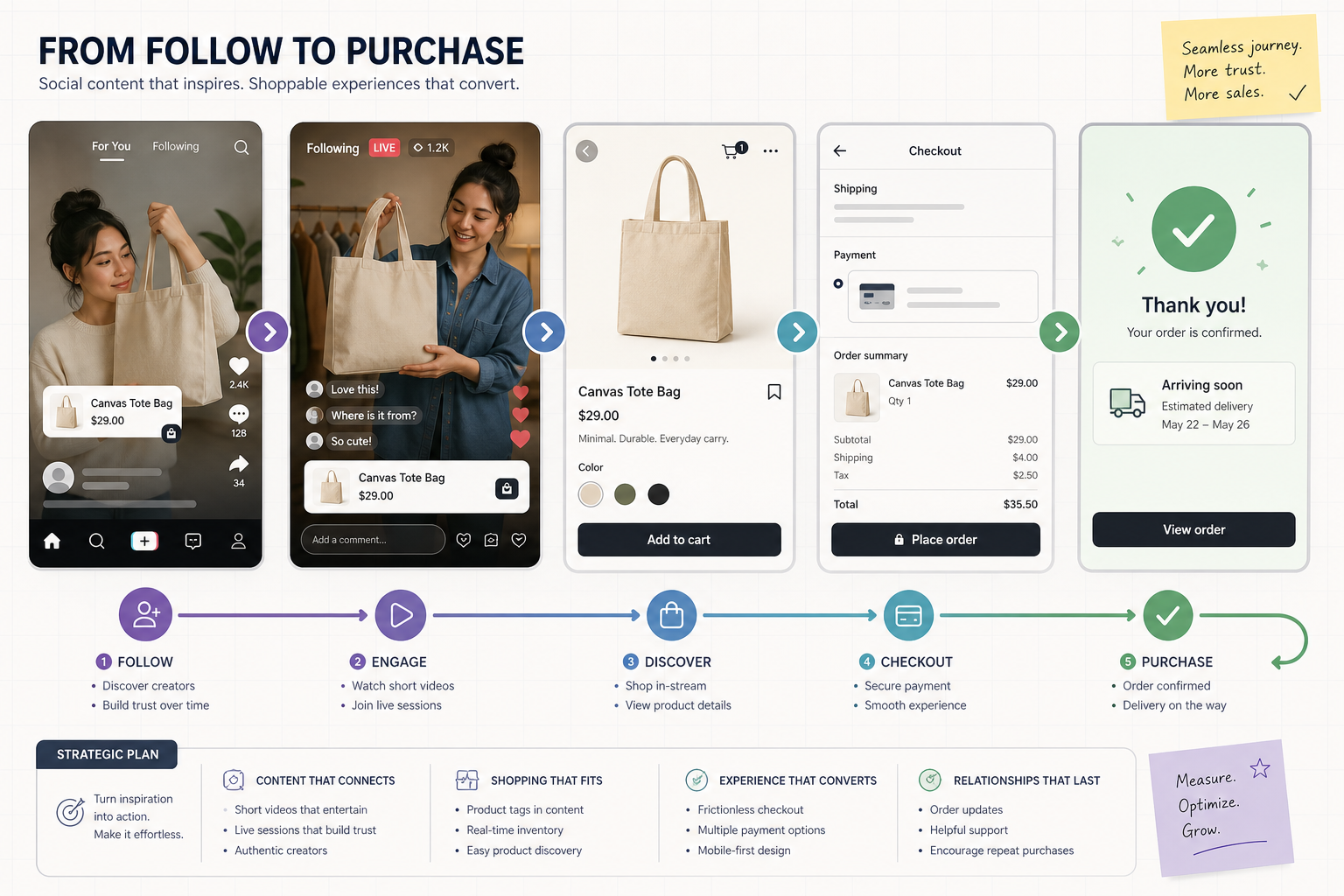
A practical guide to social commerce strategy: aligning platforms, content, and creators to turn engagement into real revenue.
Turn your social presence into a revenue channel
Build a social commerce plan that converts by starting with the right platform, content format, and creator mix for your audience.
Social commerce collapses the funnel into a single moment
Traditional e-commerce asks a potential buyer to discover a product on social media, click through to a website, navigate a product page, and complete checkout. Each step bleeds conversion. Social commerce removes that friction by embedding discovery, consideration, and purchase inside the platform itself. On TikTok Shop, a viewer watching a short video can tap a product tag and check out without ever leaving the app. On Shopee, a livestream host can pin a product link that converts in real time as the audience watches. The strategic implication is significant: the content is not a bridge to a store. The content is the store. Brands that treat social commerce as a distribution channel rather than a sales environment will consistently underperform against those that design for in-platform conversion from the start. For a broader view of the discipline, explore social commerce creator marketing.
Platform choice must follow audience behavior, not brand preference
Choosing where to sell is the first and most consequential strategic decision. The right platform is the one where your target audience already spends time and is already in a buying mindset. TikTok Shop suits brands whose products benefit from demonstration, storytelling, or social proof at scale, particularly in beauty, health, lifestyle, and consumer goods. Shopee Live is stronger for audiences who are already in a shopping session and are comparing options actively. Xiaohongshu (RedNote) is a discovery-first environment where trust is built through detailed, community-driven reviews before purchase intent forms. Spreading budget across every platform rarely works. A focused strategy on one or two platforms, executed well, outperforms a diluted presence everywhere. If you are assessing Xiaohongshu as part of your mix, this guide to RedNote brand growth covers platform-specific tactics in detail.
Shoppable content works when it feels native, not promotional
The content formats that convert in social commerce are not digital versions of traditional ads. Short videos, livestreams, and UGC posts perform because they match the look, rhythm, and tone of organic content on each platform. A product demonstration embedded in an entertaining short video outperforms a polished thirty-second commercial because it fits the context in which a viewer encounters it. This has direct implications for production: scripts should feel conversational, creators should speak in their own voice, and product features should emerge from use rather than from a list of claims. User-generated content is particularly effective here because it carries the credibility of a real customer experience. UGC marketing builds the kind of trust that reduces hesitation at the moment of purchase, which is the exact moment social commerce needs to win.
Influencer and KOL partnerships accelerate trust at scale
No element of a social commerce strategy closes the gap between discovery and purchase faster than a credible creator recommending a product to an audience that already trusts them. The distinction between a KOL (key opinion leader) and a general influencer matters here: KOLs typically carry category authority, meaning their audience defers to their judgment on specific product types. For social commerce, category relevance outweighs follower count as a selection criterion. A beauty KOL with a highly engaged niche audience will drive more conversions for a skincare brand than a celebrity with broad but shallow reach. Brands should also consider how creator content is repurposed: a TikTok video produced for a KOL campaign can be reformatted as a paid ad, embedded on a product page, or used in a Shopee livestream. Understanding the difference between KOLs and influencers helps brands make smarter partnership decisions from the start.
Analytics close the loop between content and conversion
A social commerce strategy without measurement is a creative exercise, not a growth plan. Platform analytics on TikTok Shop and Shopee provide data at the content level (views, watch time, click-through rate on product tags) and the transaction level (add-to-cart rate, conversion rate, revenue per live session). The goal is to identify which content formats, which creators, and which audience segments produce the highest conversion rates, then reinvest accordingly. Watch time and conversion rate together tell you more than either metric alone: high watch time with low conversion suggests the content is engaging but the product presentation is not closing the sale. Low watch time with high conversion suggests a highly motivated but narrow audience. Tracking these patterns over time is what turns a one-off campaign into a repeatable growth engine. For a practical framework on what to track, this guide to measuring influencer marketing ROI applies directly to social commerce performance.
The content is not a bridge to a store. The content is the store.
How to build a social commerce strategy step by step
-
Define your conversion goal before choosing a platform
Start with the outcome you are optimizing for: direct purchase, add-to-cart, or product discovery that feeds a retargeting funnel. The goal shapes every subsequent decision, including platform, content format, and creator type. A brand launching a new product category needs different tactics than one driving repeat purchases from an existing customer base. Clarify the goal in writing before any creative or channel work begins.
-
Map your audience to the platform where they buy
Research where your target customer already shops and engages, not just where they scroll. TikTok Shop users are often in a discovery mindset and respond to entertainment-led commerce. Shopee Live users are typically further along in the purchase journey and are comparing options actively. Platform fit is a behavioral question, not a demographic one. Use platform-specific audience data and, where available, category sales data to validate your choice before committing budget.
-
Build a content mix that matches the platform format
Each platform has a native content format that outperforms imported formats. On TikTok, short-form video with strong hooks in the first three seconds drives the most product discovery. On Shopee Live, real-time product demonstration with pinned purchase links converts browsers into buyers during the session itself. Plan a content mix that includes both creator-led posts and brand-produced assets, and ensure every piece of content has a clear in-platform purchase path attached to it. Short video production and UGC creation are the two content types that consistently underpin high-converting social commerce campaigns.
-
Select creators based on category authority and audience fit
Shortlist creators whose audience matches your target customer profile and who have demonstrated genuine influence in your product category. Review their past content for engagement quality (comments that show real interest, not just emoji reactions) and for evidence that their audience acts on recommendations. Micro-creators with high engagement in a specific niche often outperform macro-creators for conversion-focused campaigns. Brief creators clearly on the product, the key claims, and the call to action, but give them latitude to present it in their own voice. See KOL marketing services for how this selection process works in practice.
-
Activate in-platform purchase features from day one
Product tagging, in-app checkout, and pinned product links are not optional add-ons. They are the infrastructure that makes social commerce different from social media marketing. Every piece of content should have a tagged, purchasable product attached to it from the moment it goes live. For livestreams, this means having product links queued and ready to pin at the right moment in the session. For short videos, it means tagging products before publishing, not as an afterthought. Work with platforms like TikTok Shop, where official partner agencies can access additional commerce tools and analytics. Shopee livestream campaigns and TikTok Shop campaigns both require this infrastructure to be set up correctly before content goes live.
-
Measure, identify what converts, and reinvest
After each campaign or live session, pull data at three levels: individual creator performance, content performance by format, and overall conversion rate by platform. Identify the combinations that produced the highest revenue per view or revenue per session. Reinvest budget toward what is working and cut or rework what is not. A social commerce strategy becomes more efficient over time only if measurement is systematic and decisions are data-driven. For a structured approach to what metrics matter most, this ROI measurement guide covers the key indicators for creator-led commerce campaigns.
Benefits
Fewer steps from discovery to purchase
Social commerce eliminates the redirect to an external website, meaning every step removed from the purchase path increases the probability that a browsing viewer becomes a paying customer.
Content that earns trust before it asks for a sale
Native-format content, UGC, and creator recommendations reduce purchase hesitation by delivering social proof at the exact moment a viewer is considering a product, not after they have left the platform.
Creator authority converts faster than brand advertising
A KOL or creator with genuine category credibility can move a follower from awareness to purchase in a single piece of content, because the audience already trusts their judgment on that product type.
Platform analytics identify what actually converts
In-platform data on TikTok Shop and Shopee connects content performance directly to transaction data, so brands can identify which creators, formats, and audience segments produce the highest conversion rates and reinvest accordingly.
Strategy compounds over time with consistent execution
An always-on social commerce programme builds audience familiarity and community trust that makes each successive campaign more efficient, turning a repeatable content and creator system into a sustainable revenue channel.
Social commerce strategy in practice
A beauty brand launching on TikTok Shop
A skincare brand with an engaged Instagram following wants to open a new revenue channel on TikTok Shop. Rather than repurposing existing polished ads, the brand commissions short-form UGC videos from micro-creators in the beauty niche, each demonstrating a specific product benefit in their own voice. Product tags are embedded in every video so viewers can purchase without leaving the app. The brand tracks click-through rate on product tags and conversion rate per creator, then reallocates budget toward the two creators whose content drove the most completed purchases. Over successive campaigns, the content mix shifts toward the formats and creators that have proven to convert. UGC creation services are central to this kind of always-on content engine.
A health supplement brand running Shopee Live sessions
A health supplement brand wants to drive sales during Shopee's regular promotional periods. The brand works with a host who has category credibility in health and wellness, scripts a live session around product education and Q&A, and pins purchase links at the moment the host addresses each product's key benefit. Real-time social proof from viewers purchasing during the session creates urgency without manufactured scarcity. The brand reviews session-level data (peak viewer count, add-to-cart rate, revenue per session) to refine the script and timing for subsequent shows. Shopee livestream commerce campaigns require this level of session planning to perform consistently.
An overseas brand entering the Singapore market
A consumer goods brand from China wants to establish sales on TikTok Shop Singapore. The brand's existing content and creator relationships do not translate directly: local audience expectations, platform norms, and purchase behaviors differ meaningfully from the home market. Localizing the social commerce strategy means selecting Singapore-based creators with relevant category authority, producing content that reflects local cultural context, and using platform analytics to understand which product lines resonate with the local audience. A local market entry approach that accounts for these differences from the outset avoids the cost of rebuilding a strategy after a failed launch. Influencer marketing agency services can bridge the gap between an overseas brand's existing assets and what the local market actually responds to.
A lifestyle brand building community to sustain long-term sales
A footwear brand wants social commerce to do more than drive one-off purchases. The brand builds an always-on creator programme, working with a consistent group of lifestyle creators who post regularly about the brand's products in authentic contexts. Over time, the community of followers around these creators develops genuine familiarity with the brand, reducing the persuasion required at the point of purchase. New product launches benefit from an existing audience that is already warm. The brand tracks repeat purchase rate alongside new customer acquisition to measure whether the community-building investment is compounding. KOL campaign management is the operational backbone of this kind of sustained programme.
Common questions about social commerce strategy
What is the difference between social commerce and social media marketing?
Social media marketing uses platforms to build awareness and drive traffic to an external website or store. Social commerce keeps the entire purchase journey inside the platform: discovery, product consideration, and checkout all happen without the user leaving the app. The strategic and operational requirements are different because the content must do the work of a product page and a checkout flow, not just an ad.
Which platform is best for social commerce in Singapore?
There is no single answer, because the right platform depends on your product category and target audience behavior. TikTok Shop is strong for discovery-led categories such as beauty, health, and lifestyle, where entertainment-led content drives impulse purchase. Shopee Live suits brands whose audience is already in a shopping session and is comparing products actively. A focused strategy on the platform that best matches your audience's buying behavior will outperform a diluted presence across all platforms.
How important are influencers and KOLs in a social commerce strategy?
Creator partnerships are one of the highest-leverage elements of a social commerce strategy because a trusted creator can compress the awareness-to-purchase journey into a single piece of content. The key selection criterion is category authority, not follower count: a creator whose audience trusts their recommendations in your product category will drive more conversions than a larger creator with a generalist audience. Understanding the KOL vs influencer distinction helps brands make smarter partnership decisions.
How do I measure whether my social commerce strategy is working?
Measure at three levels: content performance (watch time, click-through rate on product tags), creator performance (conversion rate and revenue per creator), and programme performance (overall revenue, repeat purchase rate, and cost per acquisition). Watch time and conversion rate together reveal whether content is engaging but not closing, or converting a narrow but highly motivated audience. Platforms like TikTok Shop and Shopee provide transaction-level data that connects content directly to sales. A detailed framework is available in this guide to influencer marketing ROI measurement.
What role does livestreaming play in a social commerce strategy?
Livestreaming is the highest-conversion format in social commerce because it combines real-time product demonstration, audience Q&A, and in-session purchase links into a single experience. Viewers who stay through a live session convert at significantly higher rates than viewers of pre-recorded content, because the live format creates genuine engagement and social proof as purchases happen in real time. Working with a TikTok live streamer covers how brands can structure these sessions for maximum conversion.
Ready to build a social commerce strategy that converts
A social commerce strategy that converts followers into buyers requires the right platform, the right creators, and content built for in-platform purchase from the start. If you are ready to move beyond awareness campaigns and build a system that drives measurable sales, Confetti's team works across TikTok Shop and Shopee to design and execute exactly that.